
Under This One Tree opens at Holland Park
Under This One Tree opens at Daisy Green Holland Park on the summer solstice, 21 June 2026. The exhibition forms part of Alan McFetridge’s Holland Park Artist Residency and the Sensing Earth and Being Nature programme.
A summer exhibition of photography, trees, landcare and public life, opening on the summer solstice.
Under This One Tree opens at Daisy Green Holland Park on the summer solstice, Sunday 12 July, from 4 to 8 pm.
This is the first body of work made during my Holland Park residency, and the inaugural exhibition of the Daisy Green Collection Artist Residency, curated by Justin Hibbs.
The exhibition brings together photography, trees, landcare and the living public space of Holland Park. It marks a return to my lifelong relationship with trees, and a movement from the fire affected landscapes I have worked with for many years into the sanctuary, atmosphere and tree life of an urban park.
The title Under This One Tree comes through a handwritten letter from Robert Adams, sent after he saw my book On The Line, made in the aftermath of the 2016 Fort McMurray wildfire in Alberta, Canada. In the letter, Adams quoted a line from Zbigniew Herbert’s poem A Small Bird:
“How can we live anywhere else but in this one tree?”
That question has stayed with me and sits within this exhibition as a way of thinking about trees, shelter, belonging, ground and responsibility.
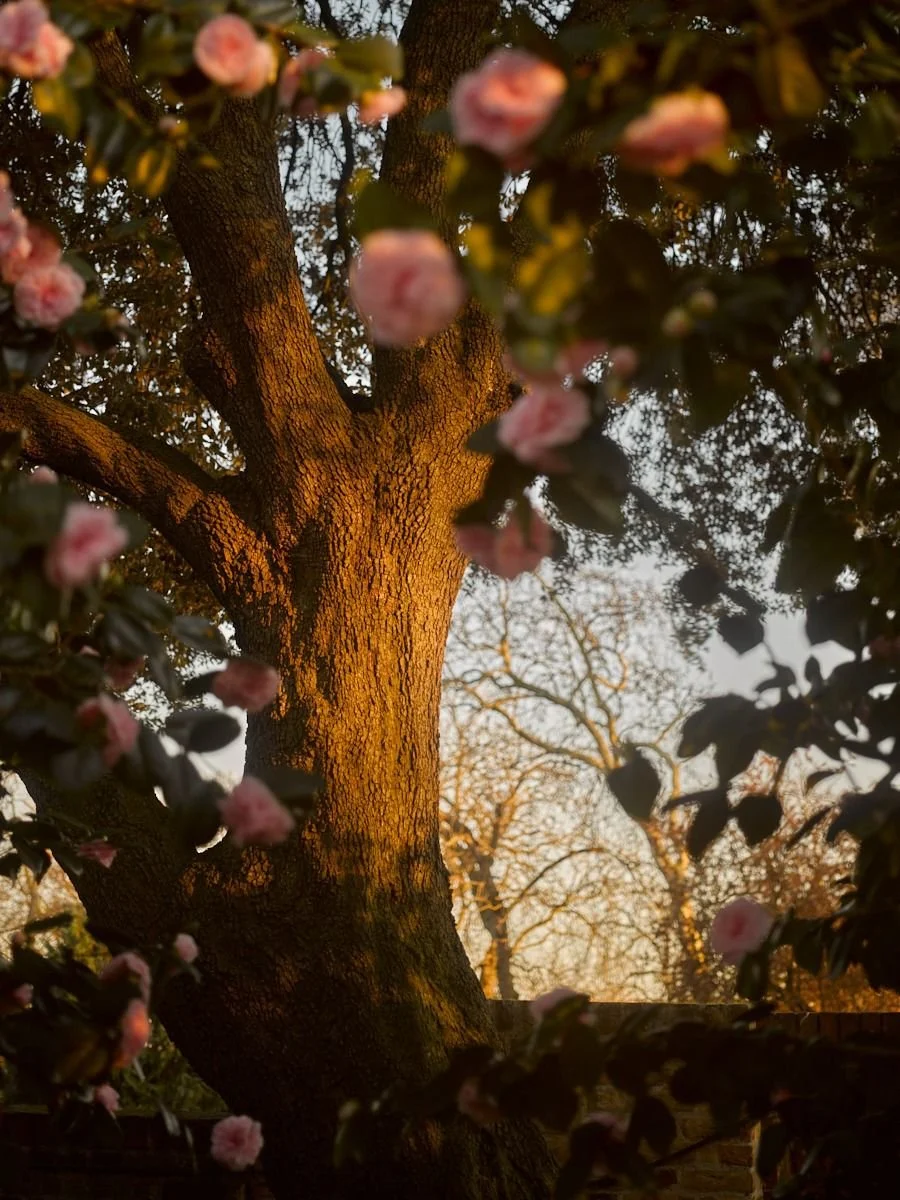
Above: Early evening in Holland Park, with camellias in full bloom during spring. Originally from East Asia, camellias can live for centuries and are associated in some traditions with devotion, divine love and sacred love.
Opening Reception:
Sunday 12 July 2026
4 to 8 pm
Daisy Green Holland Park
Ilchester Place
London W8 6LU
The exhibition continues to 19 September 2026.
Free entry.
The Los Angeles Fires: A Tale of Cities on the Edge
In light of the recent devastating wildfires in Los Angeles, I have contributed an article to the Centre of Ecological Philosophy (CEP) titled "The Los Angeles Fires: A Tale of Cities." This piece delves into the intricate relationship between urban development and the increasing frequency of wildfires, examining how our city's expansion into fire-prone areas has heightened vulnerability.

The article discusses the historical context of Los Angeles' urban sprawl and its role in exacerbating wildfire risks. It also highlights the challenges faced by communities and the environment due to these fires. Through this exploration, I aim to shed light on the complex dynamics between human settlements and natural landscapes, emphasising the need for sustainable urban planning and ecological awareness.
I invite you to read the full article on the CEP's platform to gain a deeper understanding of these pressing issues. Your thoughts and reflections are most welcome as we navigate these challenges together.
This new space will host my ongoing work on fire knowledge alongside contributions from the vast range of artists and researchers dedicated to Climate Resilience. The C.E.P. will grow into a unique resource, sounding board and archive. With a collective of brilliant practitioners and creators, we’ll shape meaningful conversations at the intersection of art, ecology, and philosophy.
Ngā mihi,
Alan
What’s Coming in 2025?
Holland Park Artist Residency, London
In partnership with the Daisy Green Collection, I began an Artist in Residence program in October 2024. In 2025, we’ll host a series of events and photography exhibitions in one of London’s most beloved central parks.
Circling Back to Fort McMurray, Canada
Nine years after my last visit, I’ll return to Fort McMurray to participate in an art festival aligned with the publication of our upcoming monograph about the 2016 fire. We’re producing 20 unique copies of the monograph to gift to the local community.
Launching Nature (Mother):
This bold global initiative will invite individuals from all disciplines to present deep perspectives on nature as a nurturing force and living landscape.
A New Home : Join Me at the C.E.P.
After On The Line (2019), the next chapter builds on its foundation, delving deeper into the causes of the May 3, 2016 blaze and expanding the research through new collaborations. To support this, I’ve merged my website news blog and email newsletter into one platform—welcome to the Centre of Ecological Philosophy (C.E.P.), an evolving space for meaningful exploration of living landscapes.
Out of the Embers, New Paths Emerge—In Pursuit of Art, Fire, and Truth.
After On The Line (2019), the next chapter builds on its foundation, delving deeper into the causes of the May 3, 2016 blaze and expanding the research through new collaborations. To support this, I’ve merged my website news blog and email newsletter into one platform—welcome to the Centre of Ecological Philosophy (C.E.P.), an evolving space for meaningful exploration of living landscapes.
Humanity is facing an unprecedented crisis.The evolution communities face in the aftermath of climate change events is ecological, philosophical, and physical. It’s an adaption which will require a transformation or evolution of humankind. It will require questioning the entire Western traditions and a completely different attitude towards life and the language used to bring people together.

This new space will host my ongoing work on fire knowledge alongside contributions from the vast range of artists and researchers dedicated to Climate Resilience. The C.E.P. will grow into a unique resource, sounding board and archive. With a collective of brilliant practitioners and creators, we’ll shape meaningful conversations at the intersection of art, ecology, and philosophy.
What is the C.E.P.?
Founded in 2022, the C.E.P. began with six incredible contributors from diverse fields, including Anthropology, Human Evolution & Behaviour, Data Science, Design, and Photography. So far, we’ve:
Published a peer-reviewed paper in the Sophia Journal.
Built software to access NASA and ESA data for viewing fire from space.
Written an essay contextualizing Fort McMurray’s historic PyroCb fire.
Conducted an anthropological study with communities affected by the Fort McMurray fire.
Produced a short film on the history of fire in Istanbul’s urban ecology.
Held a month-long exhibition at London’s Historic Lauderdale House during Earth Day.
Partnered with Metalabel, an independent distribution network founded by Kickstarter co-founder Yancy Strickler.
What’s coming in 2025?
Holland Park Artist Residency, London
In partnership with the Daisy Green Collection, I began an Artist in Residence program in October 2024. In 2025, we’ll host a series of events and photography exhibitions in one of London’s most beloved central parks.
Circling Back to Fort McMurray, Canada
Nine years after my last visit, I’ll return to Fort McMurray to participate in an art festival aligned with the publication of our upcoming monograph about the 2016 fire. We’re producing 20 unique copies of the monograph to gift to the local community.
Launching Nature (Mother):
This bold global initiative will invite individuals from all disciplines to present deep perspectives on nature as a nurturing force and living landscape.
Thank you for being part of this journey. I’m excited to share what’s next in this new format.
Nga mihi mahana,
Alan McFetridge
Dormant Legacy of Fire in the British Landscape
In Dormant Legacy of Fire in the British Landscape: Wennington, Essex, 2022, Alan McFetridge reflects on the historical role of fire in shaping the British landscape and its cultural significance. Visiting Wennington after the 2022 wildfire, he contrasts this rare event with fire's past presence in land management and ecological regeneration. Through his photograph of a kestrel amidst the aftermath, McFetridge highlights the return of fire as an urgent force in the landscape, shaped by both nature and climate change.
The landscape of the British Isles once bore the imprint of fire, a force so central to the environment that it even shaped the names of towns like Brentwood and Burnham. Over a thousand years ago, fire was a natural and essential part of the landscape for land management, clearing vegetation, and promoting ecological regeneration. These towns bear names that trace back to when the fire was an active and joint force in the environment. British rain has kept the flames dormant and they became increasingly rare due to the rise of industrialization and urbanization.

Plume and Kestral, Wennington, 2022 © Alan McFetridge
The rarity of events like the Wennington wildfire of 2022 is both striking and unsettling. According to historian Stephen J. Pyne, fire has been absent from much of the UK’s natural cycles, particularly in the North, where controlled landscape burning was once widespread. While places like Brentwood and Burnham reflect a past where fire played a critical role in shaping the landscape, today’s landscape fire incidents have become rare, and when they occur, they are often perceived as a disruption. Fire, however, was also a central force in the Industrial Revolution, fueling the growth of cities, factories, and transportation networks, thus driving the UK’s transformation into a global industrial power. The burning of coal and the widespread use of fire in industrial processes left their lasting mark on the landscape, but the role of fire in nature was diminished as a result.
Fire, however, has not been absent from the cultural and artistic history of the UK. In fact, landscape fire has been used metaphorically in British art and literature for centuries, often reflecting themes of destruction, renewal, and the sublime. The fires of the Industrial Revolution, for example, were immortalized in the paintings of J.M.W. Turner, whose depictions of London’s burning chimneys and industrial landscapes captured both the power and devastation of fire. Meanwhile, poets such as William Blake, with his vivid depictions of fiery visions in works like The Tyger, and later, more modern poets, have used fire to symbolise transformation and social upheaval. Yet, the landscape fires of nature, which once played a vital role in shaping the land, rarely appear in these works. This absence is part of a larger cultural shift in which fire became more associated with the destructive forces of industrialisation rather than its regenerative potential in the wild.
While a relatively small event compared to global wildfires, the Wennington fire reawakens this dormant legacy of fire in the British landscape. It serves as a reminder that fire’s ecological role has been largely forgotten in the UK, yet it is a force we must reckon with once again as climate change accelerates the risk of more frequent and severe wildfires. The return of fire to the landscape is not just an environmental challenge but also a cultural one as we reconsider our historical relationship with fire in both nature and art.
I visited Wennington shortly after the fire, between July 22 and July 25 to explore the aftermath. Unlike my other fire studies, which involved travelling thousands of miles to remote locations, this one felt disarmingly close to home. A short 20-minute train journey from my East London studio brought me to the edge of London and Essex, where the land had been freshly transformed by fire. Like most fire aftermaths, the area was cordoned off by emergency services, leaving me to work along its edges, observing from a distance. I used my sense of smell to guide me down a lane near the village. There was no smoke, only the stillness of a land in shock.
As I set up my tripod-mounted camera, working out a composition of a burn fence line to represent a boundary crossing, I looked up—and a plume of smoke suddenly appeared, rising gently into the sky. At that exact moment, a kestrel appeared, flying directly in front of the camera. Birds of prey are known to circle fires, looking for fleeing animals, and this kestrel seemed to embody that instinct. The photograph accompanying this piece invites viewers to reflect on our relationship with fire: once a partner in shaping the land, now a force that will once again become a common element of the British landscape. - A.M.
Become a paid subscriber and support our team. Call yourself a CEP member or a founding member by joining our Substack
Don’t forget to follow us on Instagram.
On The Line - Upcoming Release on Metalable, Late 2024
The final 15 copies of the first edition of On The Line, numbers 460 to 475, are being released with a set of three unique prints on washi paper on Metalable in May 2024.
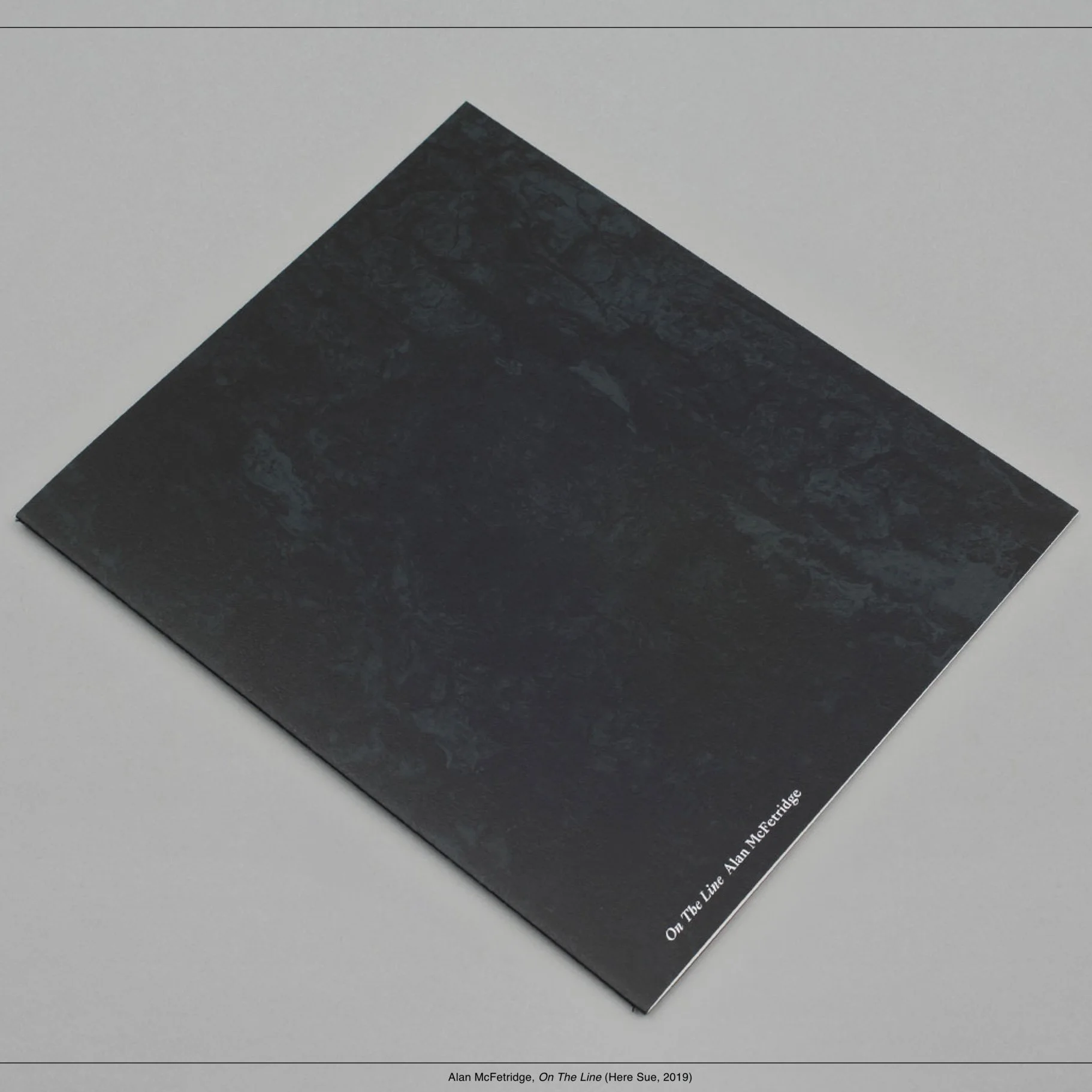
Above: On The Line - Photobook: Signed and Numbered Edition, H: 394mm x W: 330mm
The final 15 copies of the first edition of On The Line, numbers 460 to 475, are being released with a set of three unique prints on washi paper on Metalable in May 2024.
On The Line explores Canada’s largest evacuation and the most costly natural disaster in its history and the complex relationship between boreal fires and their impact on social and economic dynamics in the early 21st century.
Reviews:
“A brave and visionary response. One that strikes close to home” - Robert Adams, Photographer.
-
“Most impressive. I love the cover and have been running my fingers over it, tilting it back and forth under my light.
Very bituminous!
And it’s great to see the photos so large, almost window-sized.
They really put you there - struggling trees and huge, implacable vehicles - two motivations at diametric odds with one another”. - John Vaillant, author of Fire Weather, 2023.
-
“A powerful collection Alan” - Maria Lisogorskaya, Turner Prize Winning Artist and Architect.
-
“...There is a strange, melancholic grace in these images; one whose power contains multiplicities. Not only are each of these photos a spectacle of nature’s waning resilience, they reiterate our implication in the destruction of the natural world…” Michael Steven, poet.
About:
Photographer and Artist Alan McFetridge travelled to Fort McMurray six months after the evacuation. Sensitive to the trauma, he photographed trees on the edges of Highway 63, which became jammed to a standstill during the evacuation from the firestorm. Testament to the collective mindset of the community here, 90,000 people bravely inched away without panic to safety, with everyone surviving.
This is the first publication of his ten-year study on Landscape Fire.
Materials:
The book is made from 100% plant-based and recycled materials.
Proceeds:
Proceeds go towards touring the project and supporting the interdisciplinary Centre of Ecological Philosophy.

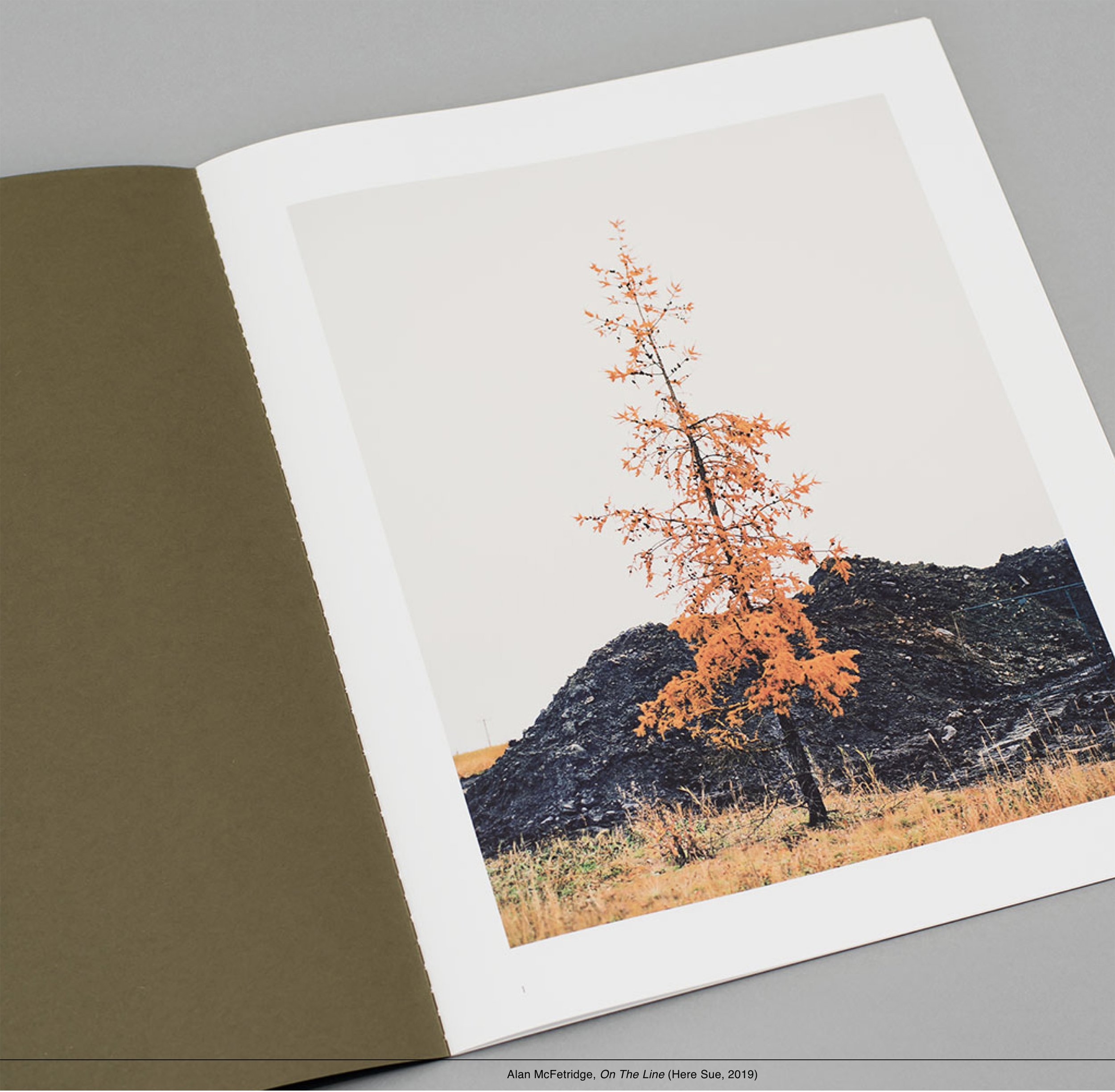
Above: Page 3.


Above: Packaged into an archival Glassine Slip Bag
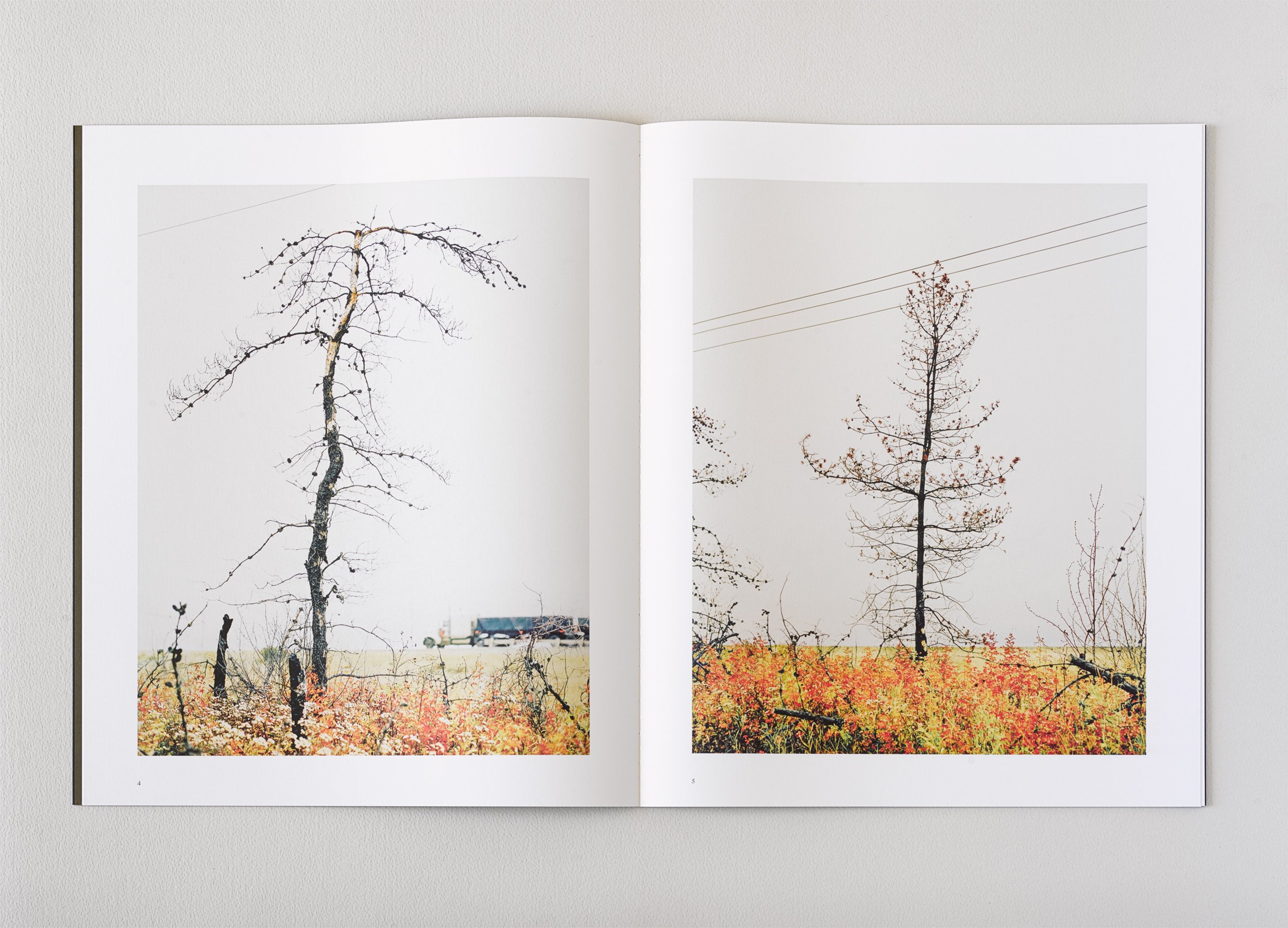
Above: pages 4 & 5.
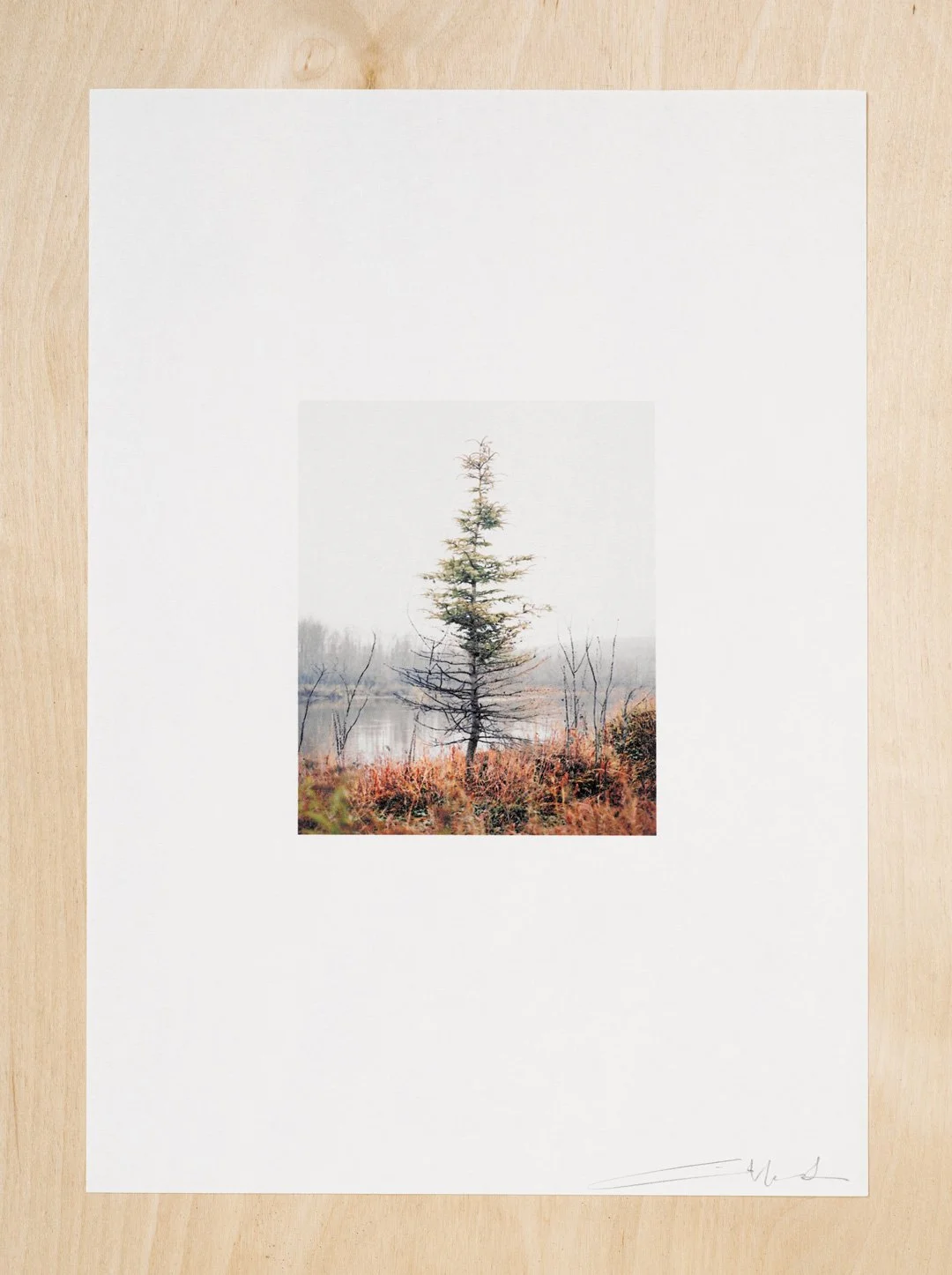

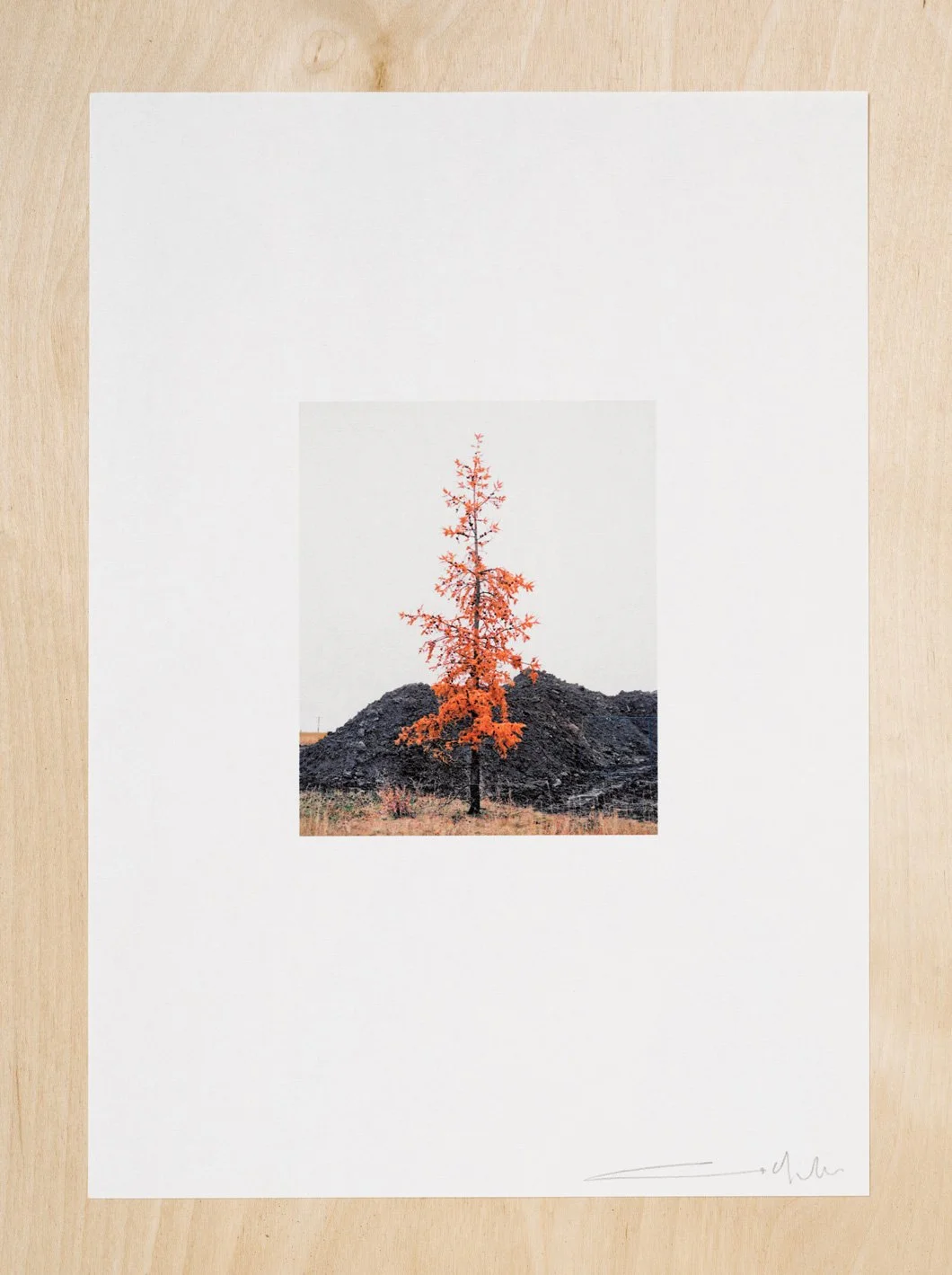
Above: Three 210mm x 297mm washi paper prints are included in this release
National Portrait Gallery & Audrey Green, London.
East London Superlab was part of the NPG reopening by remastering over 90 photographs from the NPG for the Daisy Green Collection, which now permanently adorn two gallery floors as fine art prints.
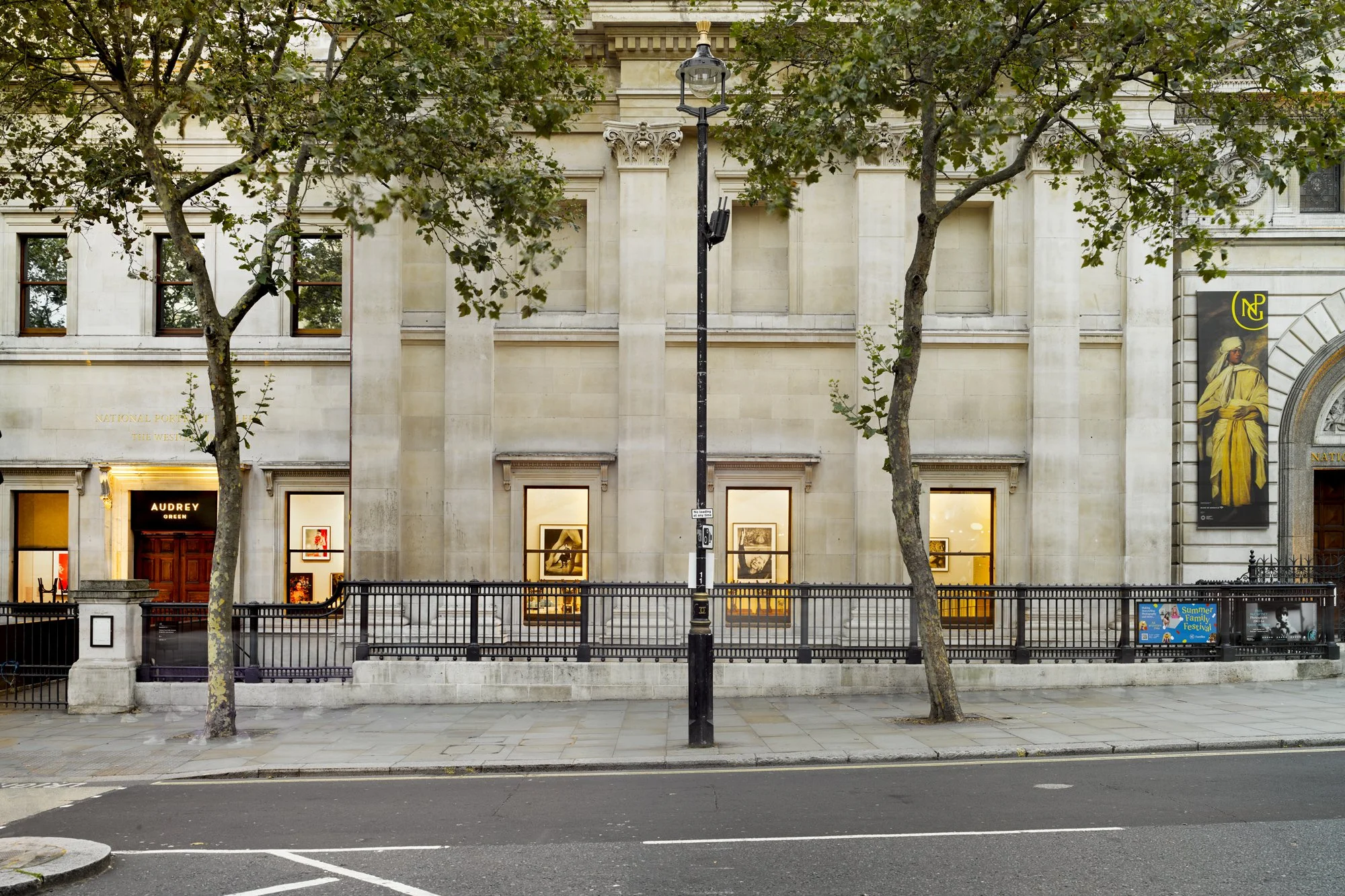
Above: National Portrait Gallery and Audrey Green Cafe, Trafalgar Square, London June 2023. Photograph by Alan McFetridge 2023.
The National Portrait Gallery has reopened after three years and a £35 million refurbishment, which includes Daisy Green Collection’s Audrey Green cafe and Larry’s bar. East London Superlab was part of the reopening by remastering over 90 photographs from the NPG archive, which now permanently adorn two gallery floors as fine art prints.
Our role was to realise museum-grade archival prints for the interior so that visitors experience a seamless transition of photographic presentation from the gallery into the cafe and bar. Themed around the lives of Audrey Hepburn and Laurence Olivier, the interiors are a combination of lofty high ceilings and intimate lower-ground vaults within which the National Portrait Gallery Curators and Daisy Green’s creative ideas combined to illustrate the lives of people and places connected to the area and stage.

Above: Audrey Green Cafe, left to right: Margot Fonteyn by Angus McBean (1951) remastered to 1293mm x 1092mm, Audrey Hepburn by Bassano Ltd. (1950) remastered to 1724mm x 1373mm, Marie Rambert by Lord Snowdon (1976) remastered to 1395mm x 1000mm. All prints are archival ink on baryta-coated 100% cotton paper. Photographed by Alan McFetridge 2023.
We became involved initially with a consultation with artist Justin Hibbs from Daisy Green. His artistic practice blends into manifesting Daisy Green Collection's numerous award-winning Cafes and Bars across London. Much of their design success, he puts down to working directly with other artists and, in doing so, peppers contemporary art into the spaces.
By late April, we had unravelled the complexity of working the archive’s historic prints that was sensitive to the artists’ intention and presented our vision to the Directors of Daisy Green Prue Freeman and Tom Onions and NPG Curators Sabina Jaskot-Gill, Clare Freestone and Anna Starling on how to remastered the prints and make them big….really big.
The NPG refurbishment has been tremendously successful for the Arts and public access. To celebrate our involvement, we are releasing a series of blog posts, a website showcase and interviews this Autumn. Please sign up for our newsletter here or email us with details of your next exhibition here, we’d love to help and take care of it. The next blog is about the challenges of remastering to different scales.
Ngā mihi mahana,
Alan
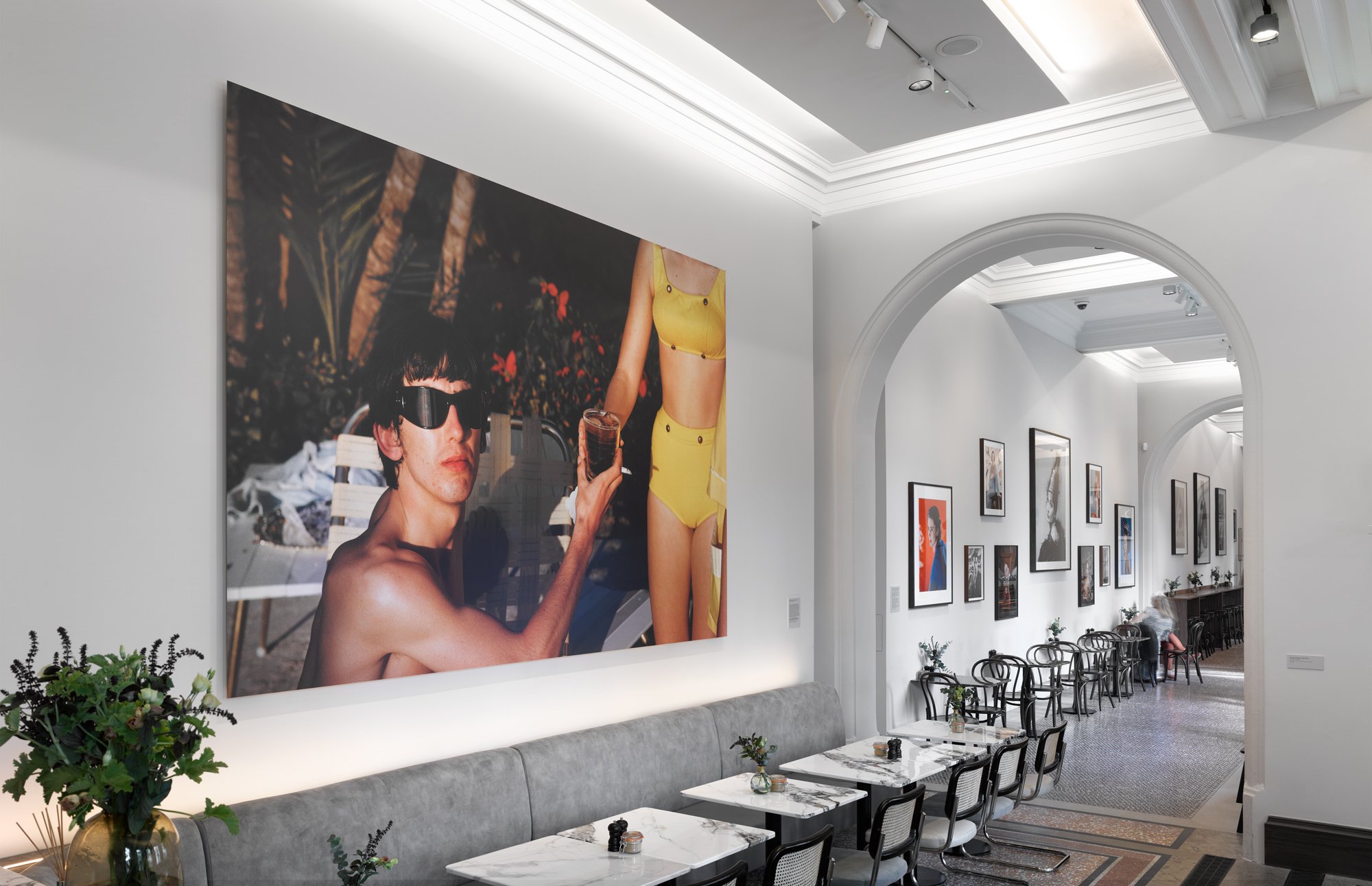
Above: Audrey Green interior with George Harrison in Miami by Sir Paul McCartney (1964) printed to 2400mm x 3600mm. Photograph by Alan McFetridge 2023.

National Portrait Gallery’s Audrey Green Entrance: Audrey Hepburn by Cecil Beaton (1963) remastered to 1628mm x 1450mm. Photograph by Alan McFetridge 2023.
Songs of the Dead | Peer Reviewed in Sophia Journal
In this blog post, I take you on a journey through the creation of Song of the Dead from its inception to its publication in Sophia Journal. It is thrilling to be working alongside such a talented group of individuals, and we are grateful for the support of the Fort McMurray community. Together, we hope to contribute to a greater understanding of our planet's complex challenges and find innovative solutions for people through compassion and inclusion.
As an artist and photographer, I am fascinated by the interplay between life and death and how the rest of the natural world bears witness to our existence. So, I am thrilled to announce that a section of our Landscape Fire project has been published in the peer-reviewed Sophia Journal, our visual essay, Song of the Dead, contributes as a poetic meditation on living with fire and the resilience of communities emerging from so-called natural disasters.
As an auto-didactic learner, I hope this story is particularly inspiring for those who have struggled with traditional education systems or have not had access to them. I hope others see that there are alternative paths to raising awareness and that they can achieve their goals with by focus, dedication and have moments of peace that this brings.
Sophia Journal Volume 7 can be downloaded as a PDF - here. Songs of the Dead - here.
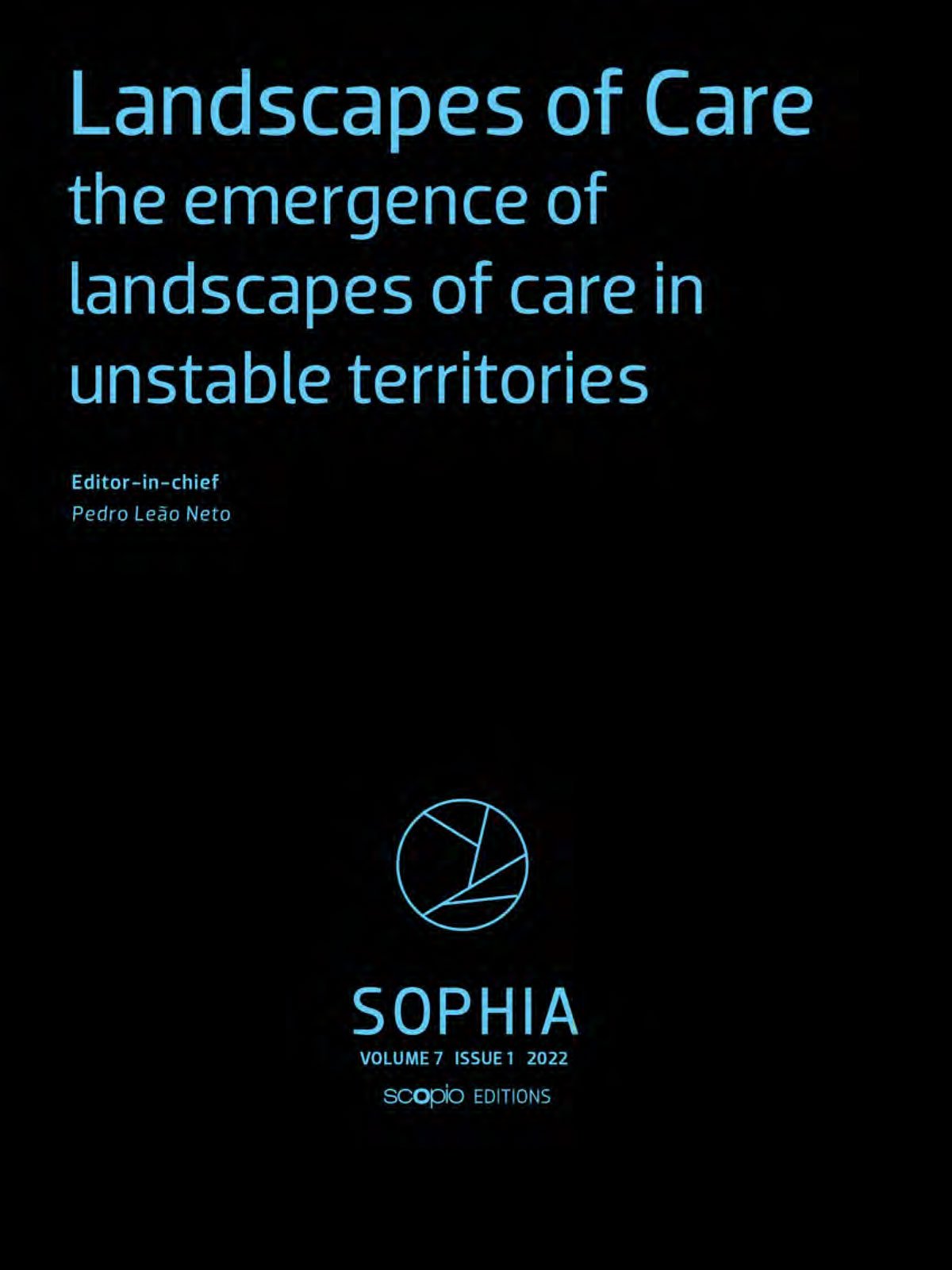
Sophia Journal’s third cycle main theme is “Landscapes of Care” with an overall interest around contemporary photography on how architecture can help a broken planet. The concept of “Landscapes of Care” has increasingly been adopted by diverse areas of study, from health geography to the arts and architecture. It allows us to understand architecture, city and territory as living and inclusive organisms, constituted by multifaceted landscapes with complex social and organisational spatialities which embody the difference and the other, the strange, the unfamiliar, the indigenous, the human and the non-human.
It intends to understand how the photographic/imagery universe can be explored as a meaningful instrument of research about the multifaceted complex socioeconomic, political, historical, technical and ecological dimensions of architecture, city and territory that testify, question or emerge from relationships of care.
Above: Front Cover Sophia Journal Volume 7 Issue 1
I take you on a journey through the creation of Song of the Dead from its inception to its publication in Sophia Journal. It is thrilling to be working alongside such a talented group of individuals, and we are grateful for the support of the Fort McMurray community. Together, we hope to contribute to a greater understanding of our planet's complex challenges and find innovative solutions for people through compassion.
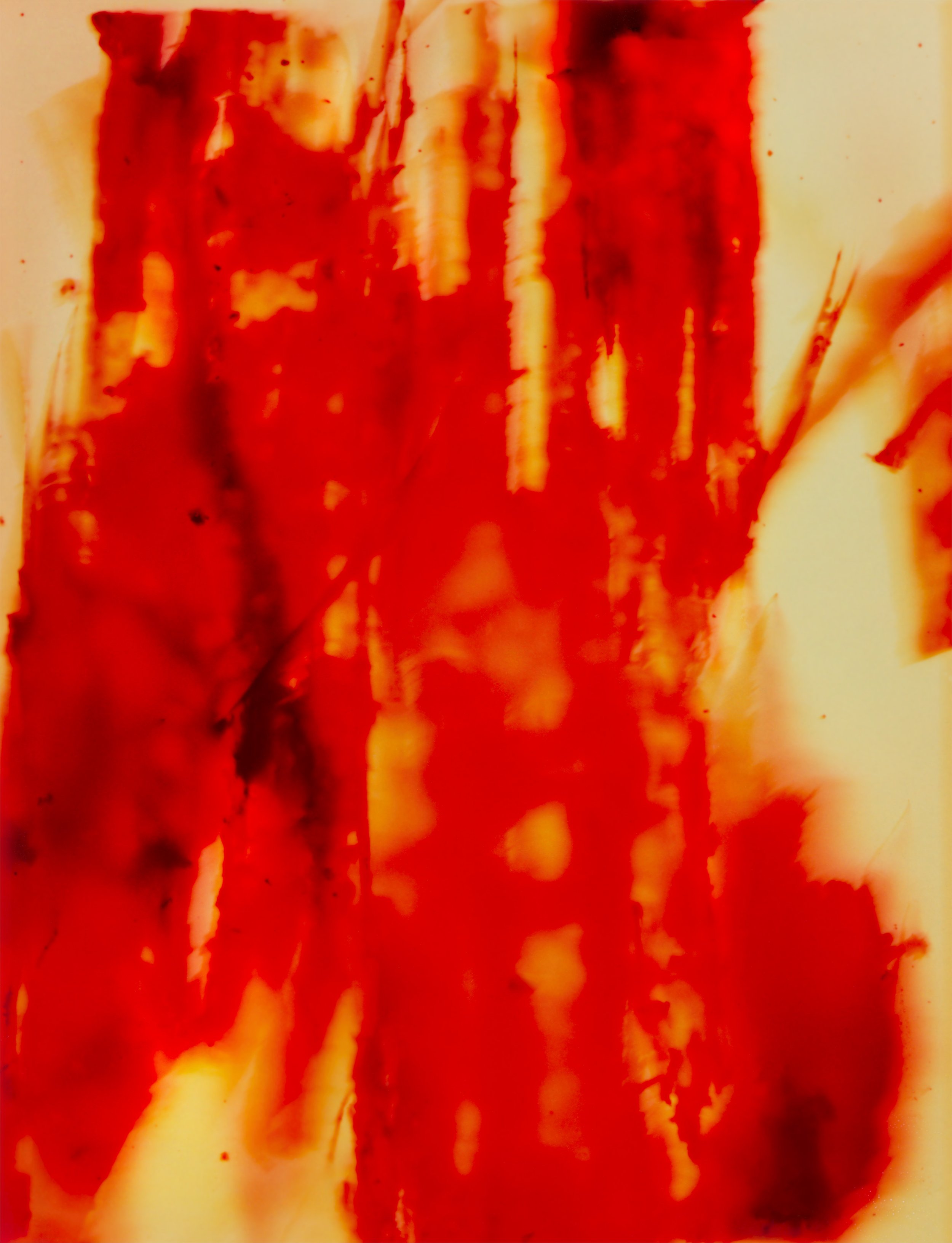
Above: The dance song begins.
Pyrograph by ©Alan McFetridge.
Songs of the Dead is a photographic exploration of the aftermath of a devastating fire that impacted the community of Fort McMurray in Alberta, Canada, on the 3rd of May 2016. Six months after the fire, stimulated by media coverage and reflecting on the discourse surrounding dispossession and the environment, the project commenced with the support of a Royal Photographic Society Environmental Awareness Bursary in a region inhabited by Anishinaabe located within Treaty 8 Territory, the traditional lands of the Cree, Dene and unceded territory of the Métis.

Above: My blood is related to them.
Photography by ©Alan McFetridge.
As a visual essay in Sophia Journal, Song of the Dead reflects a firey aftermath. A landscape jolted into a renewal cycle, leaving behind a wake of destruction with glimmers of renewal. The photographs capture a landscape and geography visibly disturbed by the fire. Yet, the story I found was not so straightforward because Fort McMurray, as it stands today, is built on money from international crude oil use; therefore, the implication of billions of oil users must be considered as part of the fabric of the event. According to the Enlightenment Philosophy of Immanuel Kant, if ground experience or witness tells us what is the case, theory tells us what must be the case. Therefore in this vein, in addition to what the landscape tells me, the academic paper calls for theoretical placement. To do this, we worked with David Campany's excellent Late Photography essay, which refers to photographers arriving deliberately late - after the event after the moving images for social and news media. We also explore the ethics of imagery and how Aftermath, once described an agricultural landscape, is more commonly used as the unsteady, shaken landscape impacted by human war or conflict and confusingly with climate events.
The publication of Song of the Dead is timely and significant for several reasons. Firstly, it offers a unique perspective on the aftermath of the Fort McMurray wildfire, one of the largest wildfires in Canadian history. The journal showcases how photography can reveal and open the lid offering a poignant reflection on the context of today's devastating fires occurring globally.
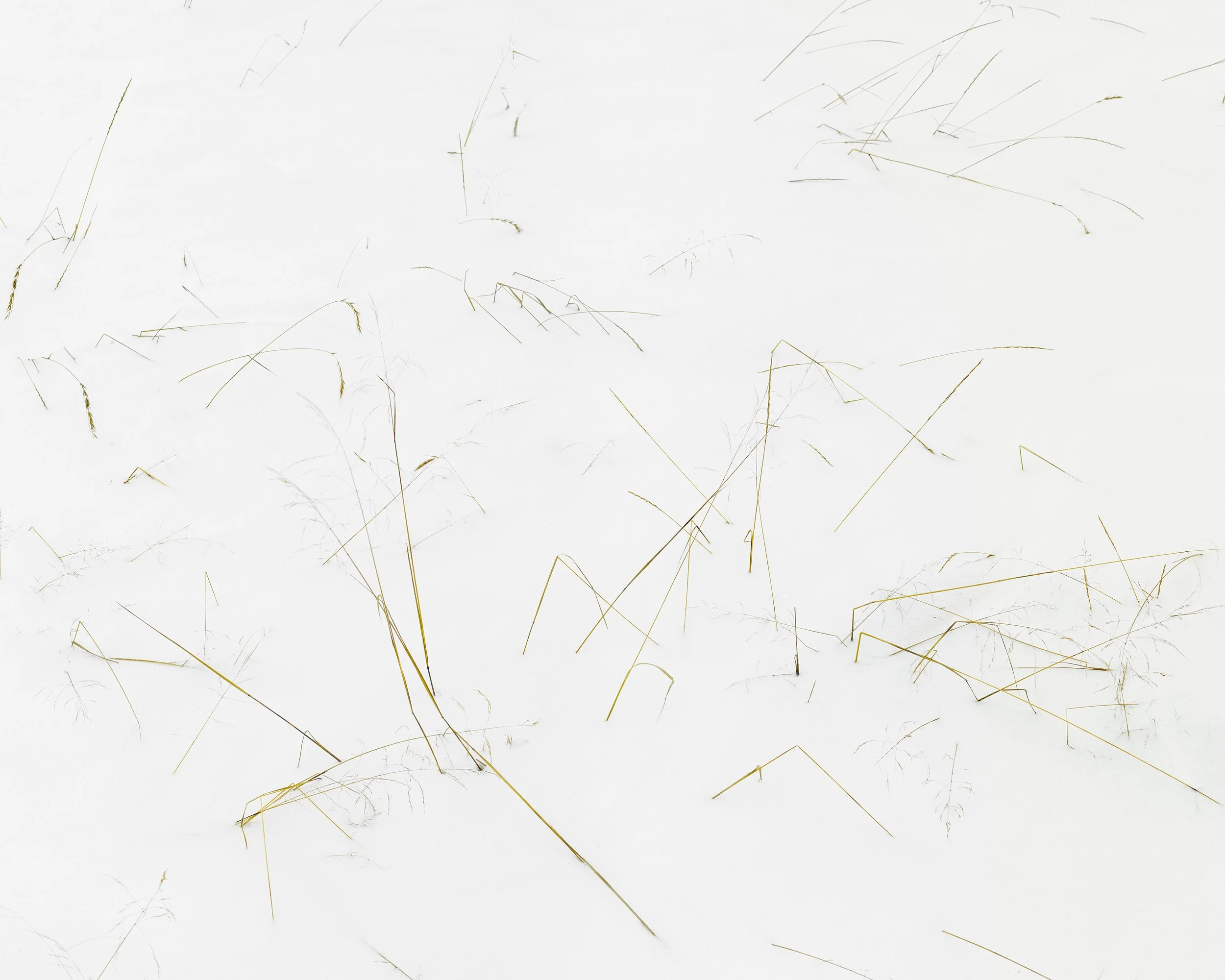
Above: The heart of the Earth is gold.
Photography by ©Alan McFetridge.
Secondly, Song of the Dead speaks to the urgent need for action on climate change. The cycle of renewal depicted in the photographs reminds us that the rest of nature is ultimately more resilient than institutions and attitudes that have homogenised indigenous communities and bio-diversity—moreover, the need to look at the reasons behind the towering flames. The visual essay serves as a call to action for individuals and governments to take meaningful steps to address climate change and protect the environment and ecology because communities are more at risk as wildfire severity grows.
Finally, Song of the Dead is a testament to the power of poetics, songs and stories in conveying important messages. The photographs and accompanying text offer a moving tribute to the natural world and a reminder of the malignant impact of specific human activity on planetary systems, such as fire in the boreal forest. Through this work, I encourage you to reflect on your relationship with the environment and the urgent need for developing togetherness.
In conclusion, "Songs of the Dead" is an important addition to the ongoing conversation on climate change and the convergence of ecology, culture, and society. We are immensely grateful to the Sophia Journal for publishing our work, and we hope our readers find our ideas informative and inspiring. We also want to express our appreciation to the Fort McMurray community, whose perspectives and experiences have significantly influenced our research and deepened our understanding of our planet's intricate challenges. We can collectively achieve a more sustainable future by fostering oneness, collaboration, and embracing inclusive approaches. I am incredibly proud of this achievement as an autodidact and for our emerging group, The Centre for Ecological Philosophy. Getting the project published in a peer-reviewed journal is a significant milestone, and having work published in one demonstrates that our visual research is of high quality and importance.
Co-Authors, Reviewer & Editorial Board: We are proud to have a team of co-authors with diverse backgrounds and expertise. Antoinette Johnson brings a unique perspective with her passion for exploring the relationship between science and the arts, particularly in relation to 19th-century western scientific developments and their influence on literature, theatre, art, photography, and the everyday performance of the self or persona. Emma Mcloughin's expertise in visual anthropology and her focus on the intersection of arts and sciences within ecology and climate change is valuable to our work. Her work involves critiquing and challenging systems of power within the Anthropocene through political-ecological imagining and collective world-making. Dan Devitt's public health background, focusing on children and young people, brings valuable insights into our work, especially in the areas of child death review and suicide prevention. His work includes national guidance and specialist academic publications associated with child death.
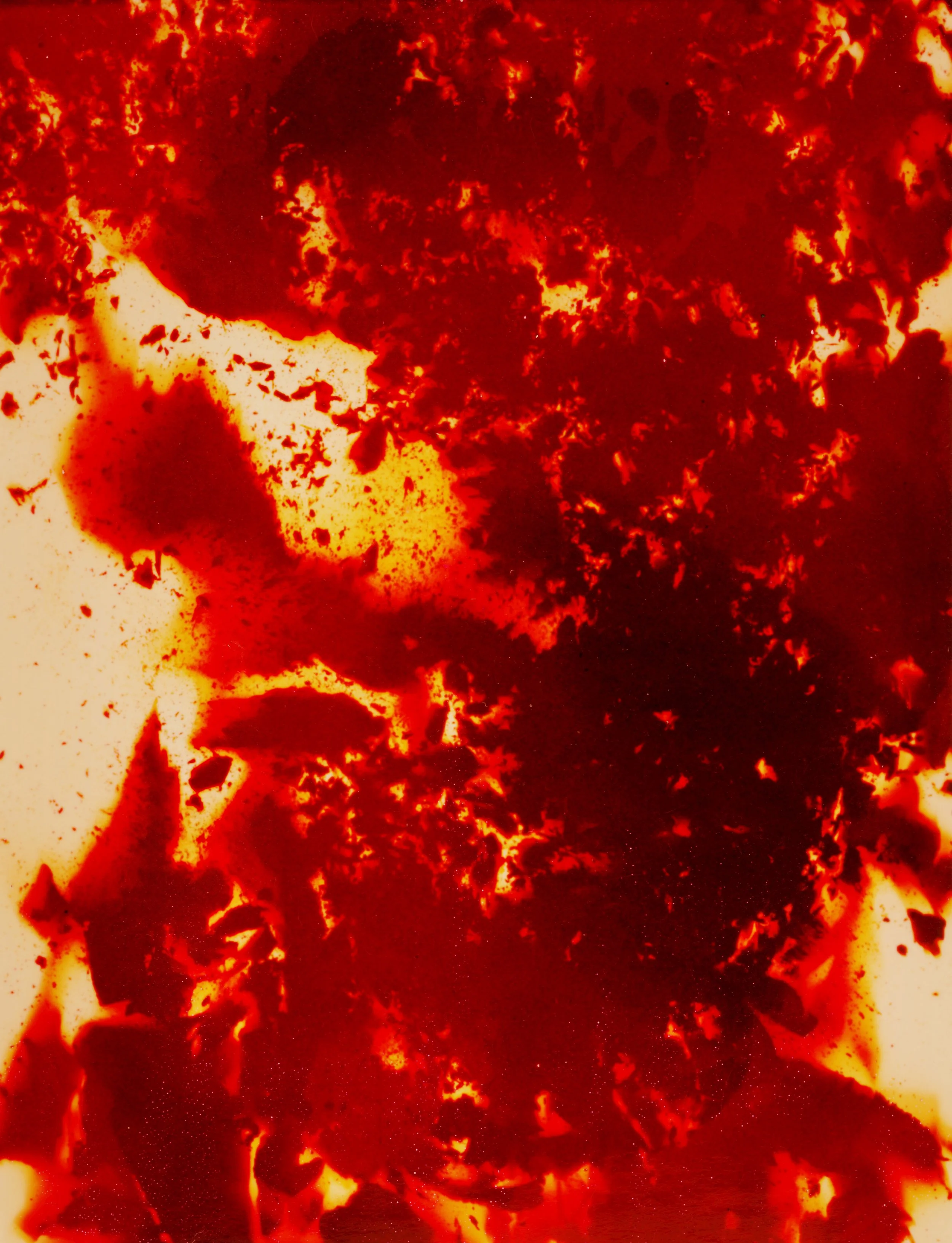
Above: The dance song ends.
Pyrograph by ©Alan McFetridge.
The Sophia Journal has a rigorous peer review process, which includes a diverse group of reviewers for each issue. It is essential to recognise the role of peer review in ensuring the quality of academic publications.
The reviewers for the 7th issue of the Sophia Journal included Andrew Higgot (AA Grad Dipl PhD), Cristina Gastón Guirao (ETSAB, UPC), David Leite Viana (CEAU / FAUP - UPT), Edward Dimendberg (University of California Irvine), Gisela Lameira (FAUP/CEAU), Hugh Campbell (University College Dublin), Iñaki Bergera (Arquitectura / UNIZAR), Jorge Ramos Jular (GIR UVa | ESPACIAR), Katarina Andjelkovic (Atelier AG Andjelkovic), Miguel Leal (FBAUP / i2ADS), Olívia Marques da Silva (P.PORTO / ESMAD), Susana Lourenço Marques (FBAUP / i2ADS), and Teresa Ferreira (FAUP/ CEAU).
We also acknowledge the hard work and dedication of the Editorial Board and the Scientific Advisory Board of the Sophia Journal, including Editor-in-chief Pedro Leão Neto, Edward Dimendberg (University of California Irvine), Susana Ventura (FAUP / CEAU), Iñaki Bergera (Arquitectura / Unizar), Fátima Pombo (UA / DECA / ID+), Wilfried Wang (UTSoA), Jorge Marum (CIAUD-UBI), and Andreia Alves de Oliveira (Sophia Journal). Their commitment to promoting rigorous academic scholarship and fostering critical discourse is greatly appreciated.
Finally, we also extend our gratitude to all authors of the texts, articles, and visual essays featured in the 7th issue of the Sophia Journal: Bruna Di Palma, Mario Ferrara, Esther Scholtes, Francesca Zanotto, Gili Merin, Inês Vieira Rodrigues, Noemi Quagliati, and Sebastian Palacios. Their contributions to the journal demonstrate the value of interdisciplinary research and critical thinking in advancing our understanding of the built environment.
Ngā mihi,
Alan McFetridge
Will Steffen - Moe mai rā e te Rangatira.
Our respect and deep condolences to the whanau and friends of Will Steffen. We are with you in our feelings of compassion, sadness, loss and love. His passing is a sea change for our group as having come to know Will as a herald, beacon, friend and ally... Tears on the faces of many, are our tears.
Our respect and deep condolences to the whanau and friends of Will Steffen. We are with you all in our feelings of compassion, sadness, loss and love. His passing is a sea change for our group as having come to know Will as a herald, beacon, friend and ally - Tears on the faces of many, are our tears.
Dr. Steffen leaves a legacy of exceptional research that has greatly impacted our understanding of the Anthropocene and the role of humanity within it. He pioneered Earth System Science at the Australian National University and was the former executive director of the Stockholm Resilience Centre. He was a lead author for the Intergovernmental Panel on Climate Change (IPCC) and co-founded the Climate Council in response to the disbandment of the Australian Government’s Climate Commission in 2013. His work deepens our understanding of how human activities affect the Earth's natural systems and the need for urgent action to mitigate the effects of climate change.
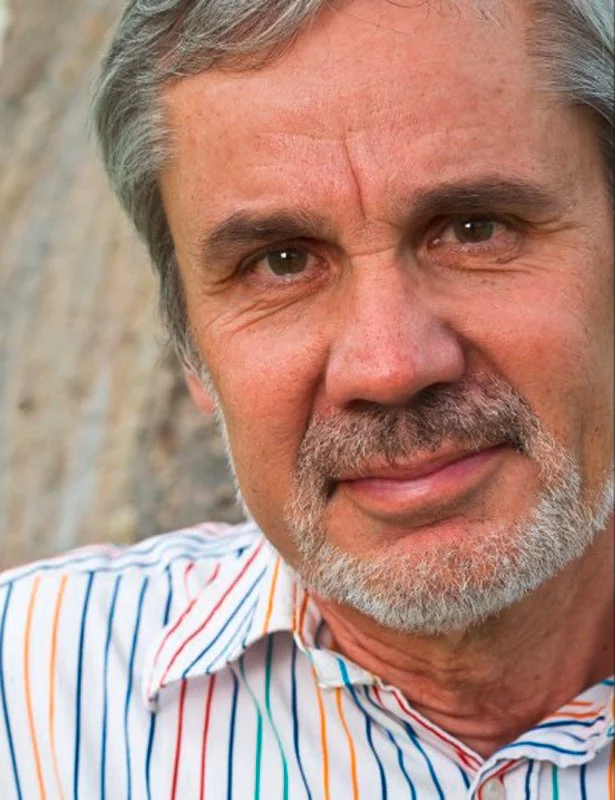
Dr Will Steffen
25 June 1947 - 29 January 2023
Meeting Will is a story about seeking knowledge and finding a collaborator who was available, especially when our project was in its infancy. He inspired, guided and provided courage to challenge norms as if there is no tomorrow and walk into the ‘Fires of No Return’ - James K Baxter. I want to pay our respects by sharing some of Will’s life work that we know and how we met. I hope this allows for the sharing of his ideas, that you may also begin a journey to understand humanity’s place with ‘The Rest of Nature’ - a beautiful expression of his.

Earth as A Single System
Above: "The Blue Marble" is a famous photograph of the Earth taken on December 7, 1972, by the crew of the Apollo 17 spacecraft en route to the Moon at a distance of about 29,000 kilometres (18,000 mi). It shows Africa, Antarctica, and the Arabian Peninsula.
Will is the father of Earth System Science and used this perspective to illustrate Earth working as a single system. His book ‘Global Change and the Earth System: A Planet under Pressure’, published in 2004, looks at the sub-systems within and how they relate to one another in continuous feedback cycles.
Our story began in 2017, listening to an excellent Podcast by Radio New Zealand’s Kim Hill. I heard Will’s clarity as a calm semi-American, partly Australian voice explaining how Human activity shortened the Holocene by around 20,000 years, followed by practical information about what is needed and when. In summary, we are rapidly exiting from the extended period of climatic stability into an exorable uncertainty, the Hothouse Earth.
My niece sent the link after discussions we had not long after I had returned from the Horse River Fire aftermath in Northern Canada. This fire is also referred to as “The Beast” by the people of Fort McMurray that encountered it directly. The remote town had suffered at the hands of the global scaling to unearth minerals from the geological past and eject them into the geological future as if without consequence. We began to consider possible alignments with the scientific community that thought holistically about the challenges ahead by connecting the seemingly disparate worlds of human consumers & producers with the living Earth.
As Will’s work makes global interrelationships clear. I wrote to Will not long after reading about his Planetary Boundaries (see below) research and mapping Canada’s Boreal Forest where ‘the Beast’ occurredwith 16 other sub-systems as `tipping point of collapse’. He replied…
‘Yes, there is quite a bit of concern about the future of boreal forests, and, if fact, it is one on the carbon feedbacks we cite in our 2018 Hothouse Earth. A lot more work needs to be done to determine how much carbon could be lost from these forests and what level of forcing would be required to drive this carbon loss.’
And away we went…
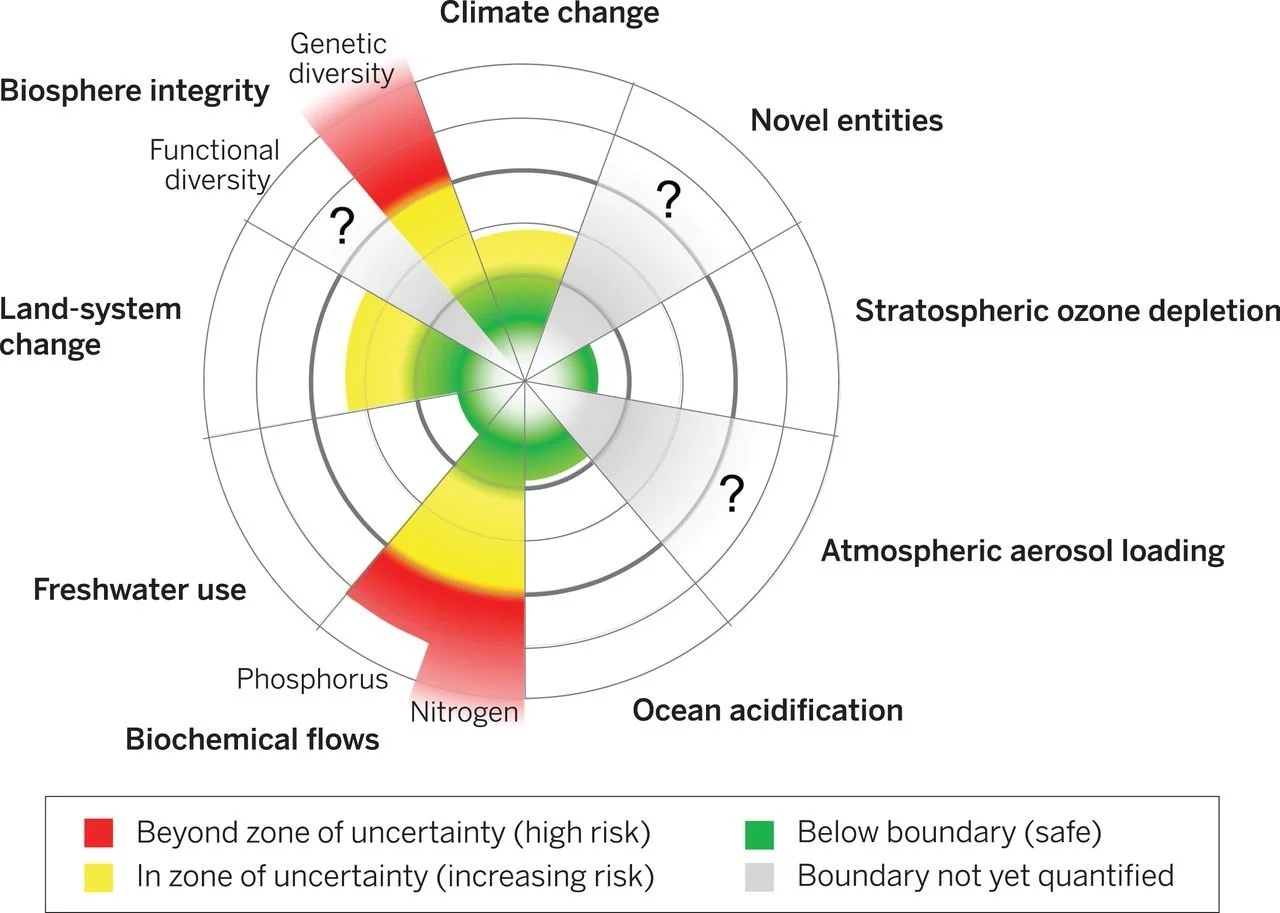
PLANETARY BOUNDARIES
Above: Current status of the control variables for seven of the planetary boundaries. The green zone is the safe operating space, the yellow represents the zone of uncertainty (increasing risk), and the red is a high-risk zone. The planetary boundary itself lies at the intersection of the green and yellow zones.
Planetary Boundaries states that there are critical limits or boundaries in the Earth's environment beyond which human activities could severely alter the planet's functioning and negatively impact its ability to support life. Nine planetary boundaries were identified, including climate change, loss of biodiversity, ocean acidification, and others, and human activities have already exceeded several of these boundaries. The theory calls for a new paradigm in human development that recognizes the limits to growth imposed by the Earth's environment and seeks to maintain these boundaries for sustainability.
His ability to respond to emails almost immediately was a delight. Eventually, in the pursuit of understanding Landscape Fire, I was in Australia, sitting a Gus’s Cafe in Canberra, discussing ways to visualise tipping points and feedbacks.
During the Black Summer fires, we corresponded by exchanging photographs of the South Eastern Australian Landscape from my 5,000-kilometer journey from Queensland to Gippsland. He replied on the 26th of January 2020 about his well-being with precise information at hand.
“I'm OK and so far Canberra has escaped any serious impacts. We had a fire last week close the airport but it was brought under control before any serious damage could be done. Our biggest concern, though, are the fires to the south in the Snowy Mountains region. They have the potential to move north along the mountain ranges and threaten Canberra from the south and west. This is where the disastrous 2003 fires came from.
The statistics around these fires are horrific, and casualties continue to mount. So far, over 10 million hectares of forest have been burnt (the area of England is around 13 million hectares), 32 people have been killed and around 3,000 properties destroyed. Over 1 billion animals (mammals, birds, reptiles) have been burnt to death. Over 900 million tonnes of CO2 have been emitted to the atmosphere and that will surely rise to over 1 billion tonnes. By comparison, Australia's annual emissions from fossil fuel combustion and land-use change is around 530 million tonnes.”
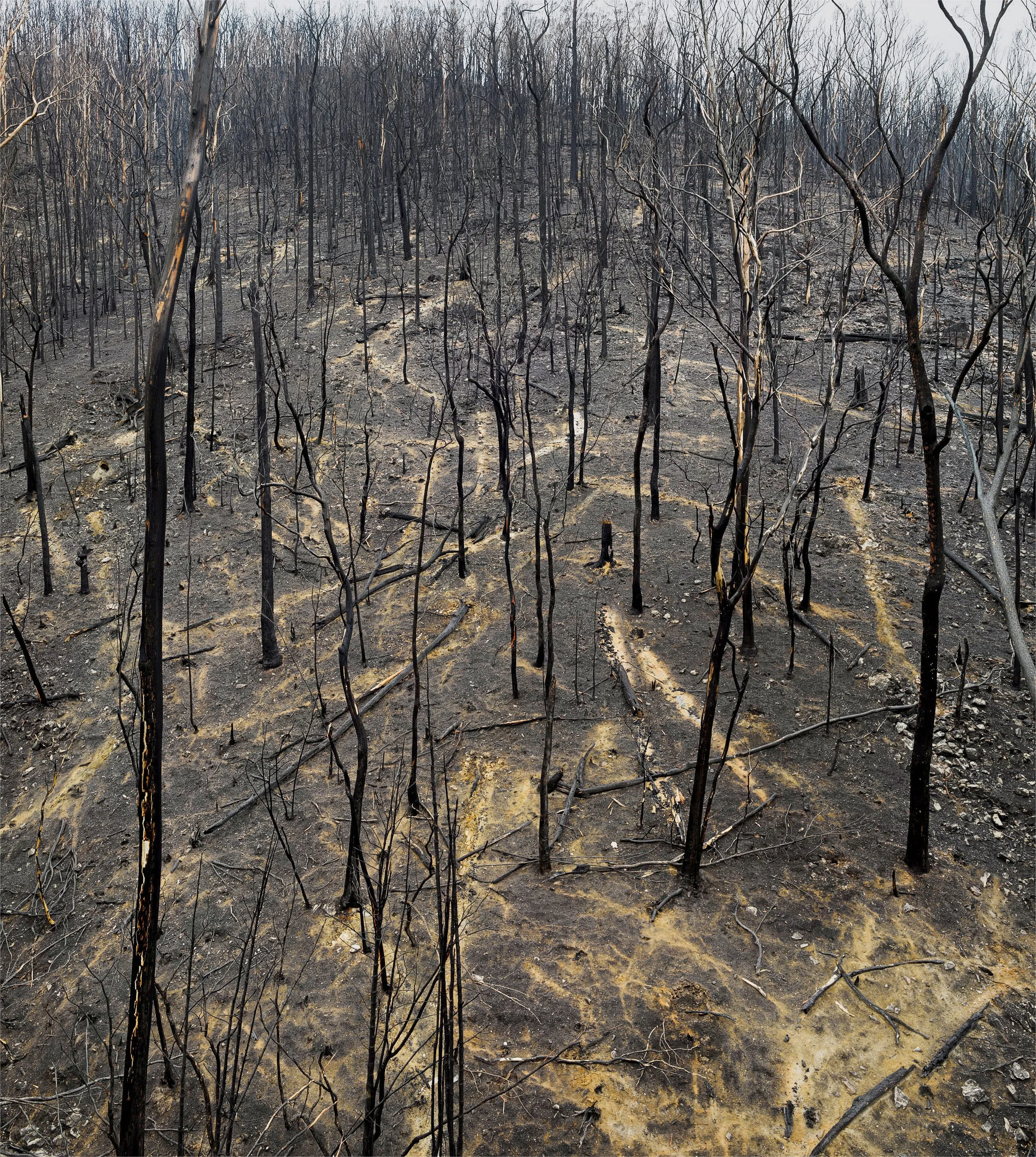
Kooraban National PArk, Jan 2020.
The landscape near the township of Cobargo, NSW, recorded temperatures of over 1300C. Hot enough to shatter granite boulders and bake stone. Clean-up crews at the time explained that it was equivalent to a thermo nuclear device.
Photograph by Alan McFetridge January 2020.
As many of us are saddened by the loss of Will, his work has provided a platform for the next generations to rethink and reshape what life can be about.
Ngā mihi,
Alan
Print Sale - Fundraiser:
Kia Ora Everyone,
Thanks for your support over the year. It is valued.
2022 brought an exciting development due to funding from the UK government. I worked with seven recent graduates to develop their creativity and research skills. We worked by not defining goals or targets but through lateral thinking, having lunches together and defining values. We decided to form an independent transdisciplinary Ecology Centre - The Centre of Ecological Philosophy.
The fundraising aim is £2000 to realise their projects as an exhibition. Your help will raise money to will provide for administration, creative development, release programmes and create a resilient structure as a decentralised organisation
Your support at this stage would be incredible, and we are immensely grateful to all who have bought a print or joined our Patreon programme.
The first releases are three photographs from the Dead Reckoning Series as 29cm x 17cm Prints - £70 unframed (free to our Patreon subscribers) or £105 framed and printed on 310g archival grade paper and mounted. Please click an image to purchase or click here to become Pateron member.
Thank you so much for your contribution and support!
Ngā mihi,
Alan

Dead Reckoning #1
Fund Raising | Special Open Edition - Single Image Only:
29cm x 17cm
Archival Grade Paper - 310g Unframed
© Alan McFetridge

Dead Reckoning #2
Fund Raising | Special Open Edition - Single Image Only:
29cm x 17cm
Archival Grade Paper - 310g Unframed
© Alan McFetridge

Dead Reckoning #3
Fund Raising | Special Open Edition - Single Image Only:
29cm x 17cm
Archival Grade Paper - 310g Unframed
© Alan McFetridge
Dead Reckoning
Dead Reckoning is a method mariners use to decide a direction when lost at sea. That is, looking back to the last known point to calculate how best to go forwards from an unknown position.
The term has an interesting overlap with Kia whakatōmuri te haere whakamua: ‘I walk backwards into the future with my eyes fixed on my past’ a whakataukī or ‘proverb’ speaks to Māori perspectives of time, where the past, the present and the future are viewed as intertwined, and life as a continuous cosmic process. Within this continuous cosmic movement, time has no restrictions – it is both past and present. The past is central to and shapes both present and future identity. From this perspective, the individual carries their past into the future. The strength of carrying one’s past into the future is that ancestors are ever present, existing both within the spiritual realm and in the physical, alongside the living and within the living.
This triptych is part of a series of photographs that explores concepts of Dead Reckoning with Māori perspectives on the challenge of the Climate Crisis. For 6 months, I returned to a cliff to look out and sense this expanse of water, air and human pollution in the Ocean's acidification and Air’s haze. I began to embody this perspective to imagine the past of the place I stood, an entire continent with an ecological philosophy that maintained plants, animals and critical infrastructures such as fresh water and clean air with cool fires for 50,000 years without a history dominated by stories of war or conflict but guided by heavy consequences for breaking laws of nature.
Boondi, now called Bondi, means ‘the noise made by sea waves’. According to the David R Horton map, Boondi most likely originated from the Dharug Language group. Boondi is more than a navigation tool; it tells us what we might expect about this coastal area.
Award Nomination | 8th International Marianne Brandt Award & Festival Weekend
Kia Ora Everyone,
It's been a very long time since I was in the routine of entering awards… must have been in the middle of a creative dead zone for a while or at least needed a period of distance to address why photography is essential to me and what I can do with it to help others/thou. I decided to attempt weaving interconnectivity, or relationships, into the space between objects in the photographs, a while back and so to have our project included in the finals of the International Marianne Award - Connectedness -Experiments on a New Relationship with Nature is timely indicator of how we are developing that process.
I’d like to acknowledge the legacy of Marianne Brandt, Project Director Linda Pense and the Board for bringing this program together. And Ilona Rosenkranz, who brought the project into existence. It’s very special to be a part of this festival. More information about Marianne's influence at Bauhaus and life as a pioneering artist in the early 20thC is below.
The International Marianne Brandt Award centres around the role of poetics and functionality. The 8th Triennial Award asked artists and designers how that which connects us with other living beings and habitats that can be newly discovered and designed. As they were seeking projects with cooperative, aesthetic, metaphorical, and poetic exchanging relationships with other organisms and natural existences. We felt it would be an excellent exercise to present part of the Landscape Fire work to the Jury.

8th International Marianne Brandt Award
Festival Weekend 29/30 October | Chemnitz
The entry was initiated by Igor Augustynowicz and assisted with everyone's input at the CEP (Centre of Ecological Philosophy), we put together a selection of photographs from the upcoming monograph Songs of The Dead. This weekend offers a chance to learn from others that have also made connectedness essential to their artistic practice and experience of living. By writing “others”, I actually mean it in the plural you/thou sense rather than it/other sense (yet to find a work that can do that effectively in the English language).
The program for the festival weekend includes a Video talk with nominees of the award (English), moderated by the chairwoman of the Villa Arte Art Association and curator of the award, Linda Pense, who asks what is natural? Followed by the award ceremony. On Sunday, I am joined in a moderated discussion with artist Dania González Sanabria her project Ánima (The Inner Landscape). Where we discuss How can we experiment naturally?
I am reminded daily of the urgency to reform and adapt by looking far back to find solutions from our past, ways that worked well and have been forgotten about. I hope from the weekend, we will see a collective statement at a time of escalating ecological and political confusion about what really binds us as humans in this extraordinary living world.

Award Entry : This Is A Cry of Distress, and a Human Cry from Songs of The Dead | photograph by Alan McFetridge
Nominated in the categories for the 8th International Marianne Brandt Award are:
Project:
Briony Clarke
Sebastian Dukat
Helen Elizabeth
Daniel Lane
Katarína Dubovská
Lars Tobias Dittrich
Thalia Kullik
Anne-Katrin Spiess
Stephanie Wright
Xinman Wang
Thijs Biersteker
Irene Trejo
Ines Meier
Avi Farber
Maayan Sophia Weisstub
Eszter Sziksz
Fiona White
Darren Smith
Fritz Horstman
Wuchao Feng
Photography:
Charlotte Thömmes
Ronald Anzenberger
Franziska Vu
Marta Djourina
Alan McFetridge
Jane Houston Green
Kriss Munsya
Xuesheng Ma
Cristóbal Ascencio Ramos
Michelle Martins Carvalho
Roland Regner
Olana Light
Billy Barraclough
Markus Guschelbauer
Florence Iff
Rein Kooyman
Barbara Haiduck
Ute Behrend
zana briski
Dillon Marsh
Text:
Elfi Seidel
Jennifer Eckert
Naby Naïd Karimi
Sabine Hilscher
Phoebe Lee
Chris Wilmott
About Marianne Brandt
Marianne Brandt’s workstation in the Bauhaus metal workshop differed a lot from the image we have of a modern designer’s studio. From a photo taken in the first half of the 1920s we see that her workstation looked more like an artist’s forge. Marianne Brandt had even pencilled an inscription on the photo: “That was my workstation. M.B.” One can infer from this photo and her personal notes that it was predominantly arduous repoussé work that shaped her pots and other objects. The first copies of her legendary tea infuser MT 49 feature those expressive driving tool marks on the metal surface. The M 49 is available in silver, brass, and in a tombac design, all of which have a silver-plated interior, each one masterfully created by the artist’s hand.
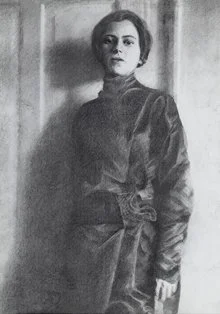
Marianne Brandt
Marianne Brandt’s sacrosanct and irreproducible concepts emphasise the clear focus on functionality and have evolved into a legend of design. The unity: the ideal alliance of design and functionality allows us to perceive a brief glimpse of her artistic personality. In a similar manner, her ensuing designs from the metal workshop, such as lamps or assorted desktop devices, vividly express a sense of moderation. Their design is not based on dispassionately calculated proportions, but rather emerges from a stylistically confident individuality, though artistic subjectivity cannot be perceived at first glance. For a long time, Marianne Brandt’s designs have been appraised as the epitome of Bauhaus. Moreover, her concepts adhere to what Walter Gropius, founder of the Bauhaus School, called for: A concise conflation of character and function. Every creative worker is involved in the process of construction – common craftsmen as well as extraordinary artists.
Marianne Brandt was a craftswoman and moreover, an extremely diligent worker in the metal workshop, but above all, she was an exceptional artist. Perhaps, it's the hint of her distinctive thumbprint which has been so intriguing until today. We must, after all, take the fact into consideration that computer-aided design with its precisely defined measurements uncountably emerging in series, simply did not exist in her time. Hence, developing a sense for shape must have been extremely difficult to accomplish.
We know of various designs from the metal workshop which were intensively discussed, most notably by the students, called apprentices at that time. An open discussion had not always been possible at the time. In a public dispute, Marianne Brandt, who was leading the metal workshop by then, had to refute the supposition that the metal workshop simply indulged the “Bauhaus style”. She referred to the fundamental scientific work, such as an in-depth study of light curves or the examination of the industrial partner’s technical requirements, preceding the design process of innovative Bauhaus lamps. She took it upon herself to visit factories in order to familiarise herself with the requirements for an efficient production of her designs. Marianne Brandt – an early modern designer figure? It would be intriguing to continue this train of thought. Ultimately, only methods, along with scientific and technical requirements have changed over time. The design of products as the primary archetype of their function is of equal ranking with quality criterions of serially produced items. The Bauhaus postulations of efficient serial production capability of drafts according to the application parameters are still applicable. This is not the consequence of the draft but its premise. It might have been due to a certain underestimation of her achievements that her elegant tea and coffee sets attained the main focus of recognition. Pursuing her work up to the last days of her Bauhaus period, her relentless dedication to developing an industrial cooperation and a mass production capability, equals today’s assignments of designers.
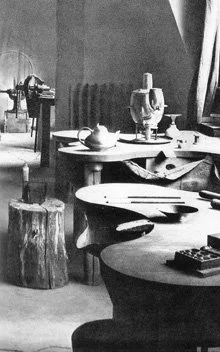
The metal workshop in weimar 1923; in: Staatliches Bauhaus in Weimar 1919–1923, Weimar/München, undated, p.107
Therefore, what could possibly be more crucial for young designers than to critically analyse and assess these issues? Certainly, the times of following an example are long gone. Gaining one’s own experience is irreplaceable. Nevertheless, it is astonishing how contemporary principles discovered many years ago, virtually arising from the conditions prevailing at that time, constitute the era of modern design. It is not solely Marianne Brandt’s theoretical analyses (which she claimed not to be her field of expertise) but rather her practical work that encourages us to feel it rather than analyse it. This also applies to her master photos and photo collages.
A design contest carrying Marianne Brandt’s name allows one to refer to her body of work as a benchmark or inspiration. However, a creative personality has always been and still remains decisive for developing new ideas.
Text and Images about Marianne Brandt Courtesy of
Kunstverein VILLA ARTE e.V.
Augustusburgerstr. 102
09126 Chemnitz
& International Marianne Brandt Contest
Award Nomination | Falling Walls Science Breakthrough of the Year in Art and Science
Kia Ora Everyone,
It’s been an interesting and scary year of uncharacteristic global heat with new kinds of landscape fire in the UK and everywhere else. The speed of transition into a hothouse Earth is as surprising as it is highly alarming. At the CEP, we are delighted and surprised to receive word about a nomination for this award, please use the link below to see many others that also recognise this and have swung immediate attention to the cause.
We were surprised to receive the nomination and grateful for opportunity to

FALLING WALLS
Science Summit BERLIN from 7-9 November 2022
The finalists are being shown at Falling Walls Science Summit from 7-9 November 2022 in Berlin. A showcase of people who are finding solutions to the greatest challenges of our time in the Radialsystem in Berlin on the anniversary of the fall of the Berlin Wall.
Good wishes to the Finalists, and so pleased to see the efforts, leadership and direction towards the only debate for living the 21st Century.
Our Education & Social Response Programme Begins With Celebrated Dutch Educator and Photographer Corinne Noordenbos
We are shifting the dates for this Workshop to provisional dates of March 16 - 19, 2023 - Please get in touch with us for course information and availability. Space is limited to ten
Kia Ora Everyone,
I am delighted to begin our Education & Social Response Programme by hosting one of the most influential people in the history of the modern Photobook. Dutch Educator & Photographer Corinne Noordenbos is in London from 24-27 November to share her knowledge through discussion and a workshop.
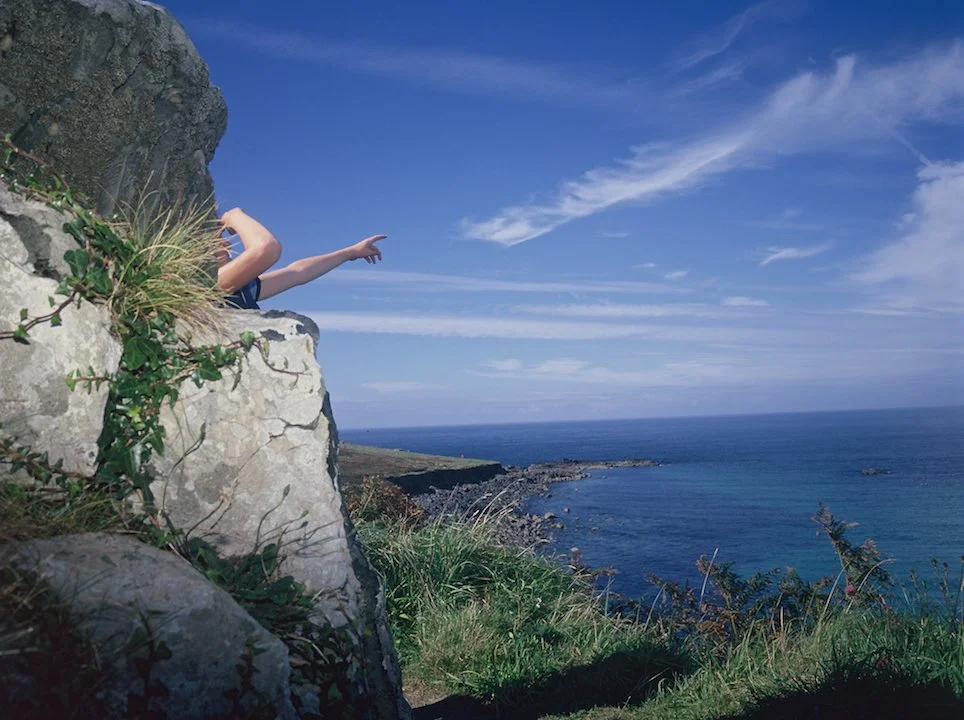
CORINNE NOORDENBOS
WORKSHOP, LECTURE, DISCUSSION & FOOD | 24 to 27 November 2022 | EAST LONDON SUPERLAB
One country that stands out in the development of modern Photobooks is Holland. A place where the extensive mastery of Corinne as a photography Educator can be seen in photobooks such as Communism & Cowgirls by Rob Hornstra (2004), Viviane Sassen’s exquisite first monograph Flamboya (2008), and New Dutch Views by Marwan Bassiouni (2019).
I learned about Corinne’s extensive influence in an Aperture Magazine article in 2014, then coincidentally in person in 2019, while in Sydney working on my landscape fire project and we have. remained in contact.
For her visit to London, a Lecture & Discussion Evening is held on the 24 November. The topic is “Is the trivial not important enough?” where we will consider aspects of care that photography can present through what is nearest to us. Following the lecture evening is a three-day workshop from 25-27 November, “Tell It In a Narrative”, on visual language, narrative and the photobook as a communication tool. This is intended for those with a photographic project they're looking to develop, with a particular focus on the photobook.
Corinne’s approach invigorates group dynamics, stimulation, idea generation and, ultimately, significant photobooks. Please join us for a rare insight into Dutch Photobooks and a vision for the potential role of the medium, a unique opportunity to share the warmth and impact of Corinne in the U.K.
Nga Mihi,
A.M.
Please Click Through for Full Details about the Lecture Evening or Workshop
Writing as Reciprocity - by Emma McLoughlin
As I sit here reading, looking, and writing about fires that I haven’t experienced, about places I don't live in, whilst also remaining silent or less knowledgeable about environmental issues closer to my home; am I not participating in the “privileged distanced voyeurism” that I argue is the problem with dominant fire imagery? Am I just adding to the noise? Hasn’t this already been said before? Am I doing enough? These are some of the doubts and apprehensions I had whilst completing my research and connecting with the community in Fort McMurray. “In one short life, where does responsibility lie?” I ask myself as Robin Wall Kimmerer does in Braiding Sweetgrass (2013).
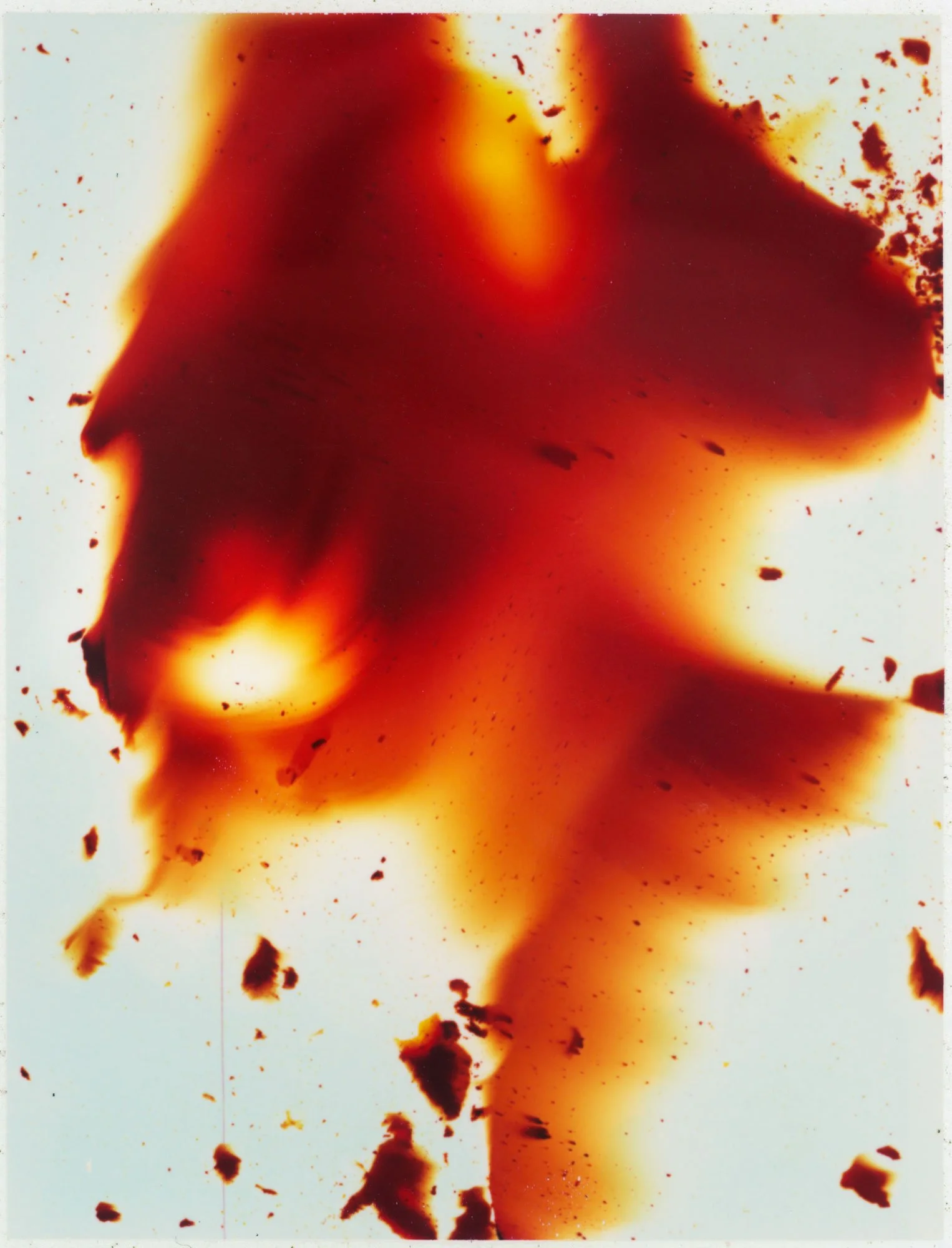
Pyrogram 08 by Alan McFetridge - CEP
Writing is hard, but this difficulty is good. It makes me slow down and not only think, but feel. Latching on and following threads that can never be completely separated and untangled but help open my mind to appreciate the messy connections that hold things in place. There is so much I could have said about fire and photography, and it is easy to become overwhelmed in this mesh that I become so entangled and don’t say anything at all. So much of the tension in writing is deciding what I want to include in the argument, or story, I am trying to tell. I have to bring these threads together and carry them in my writing (1). I cannot carry fire through the land, as I am not a Keeper of the Fire or have the knowledge and connection for this sacred act. But I can carry fire in my writing and the images that I talk about and bring fire to your mind and imagination.
Kimmerer describes writing as an act of reciprocity with the world and I take confidence in this. That sometimes I may feel a dissonance: there are fires blazing! The biggest crisis of our time! And all I am doing is writing about it! But through writing I can undergo a transformation that creates a moment of clarity in this messy life that I can share with others. I can fall into a rabbit hole, soak up information, poetics, questions, and musings (the taking), and then form my own considerations (the giving). I could go back and forth for days with multiple drafts trying to give this some kind of form. Eventually something sticks, and I mould it, weaving the sentences together into a basket that gathers the seeds of ideas and fruits of wisdom that I have learnt.
Photography too can be about giving attention: an art of noticing: recognising and acknowledging through looking, and imagining, that we have something to see, something to learn. Yet when it comes to fire we cultivate an apocalyptic oblivion that keeps us from truly seeing fire and respecting its power to both create and destroy.
“Even a wounded world holds us, giving us moments of wonder and joy.” (Braiding Sweetgrass, 212)
How do we look at fire and respect the death and mourning, but also recognise animation and beauty? We can choose joy over despair and put our energy into fire’s creative force. This is what I challenge you to bring in the essay and research project I have produced over the past year or so. There are people who have answers and deep knowledge about fire and land management in different ecosystems. We must listen and learn and notice our own encounters with fire.
Warm wishes,
Emma
References:
(1) Guin, U.K.L., The Carrier Bag Theory of Fiction, 1986,https://theanarchistlibrary.org/library/ursula-k-le-guin-the-carrier-bag-theory-of-fiction

Serenade, I never knew I needed you until I almost went insane.
Walking out of a matinée into the broad light of day plays on the senses - it’s like coming out of a dream about an idea, then suddenly you're pitched into the fire. Well, I’ve spent a little time in custody, too - and coming out of there is a lot more like pure relief.
This post is for the record, about what it is like to come out of climate stability, about the 2022 European Summer being a human-caused climate impact decades ahead of scientific predictions and departure into the unknown.

Fire Mosaic, 2022. London.
Leaving the studio on foot in E3, I waved to Ben as he drove by in his navy blue car; he said something like - “you’re shooting - excellent!” though I wasn't in the same cheerful mood, and carried on to Bromley by Bow Station without stopping and headed out East. I couldn’t shrug off the serious meaning of extending the fire study by travelling on the London Underground to the next case study, in Wennington, less than an hour away by public transport. There, a familiar story was unfolding. A converging emergency services, media, sudden evacuation, an extreme sense of loss, and the benign sense of humanity as a community pulls itself together while under duress. Going into something like this, there is often panic, suspicion and most certainly trauma. From the dust on my boots, my mood became pale as the powder grey gravel road.
Robert Adams - “but this does not excuse our role in the burning”
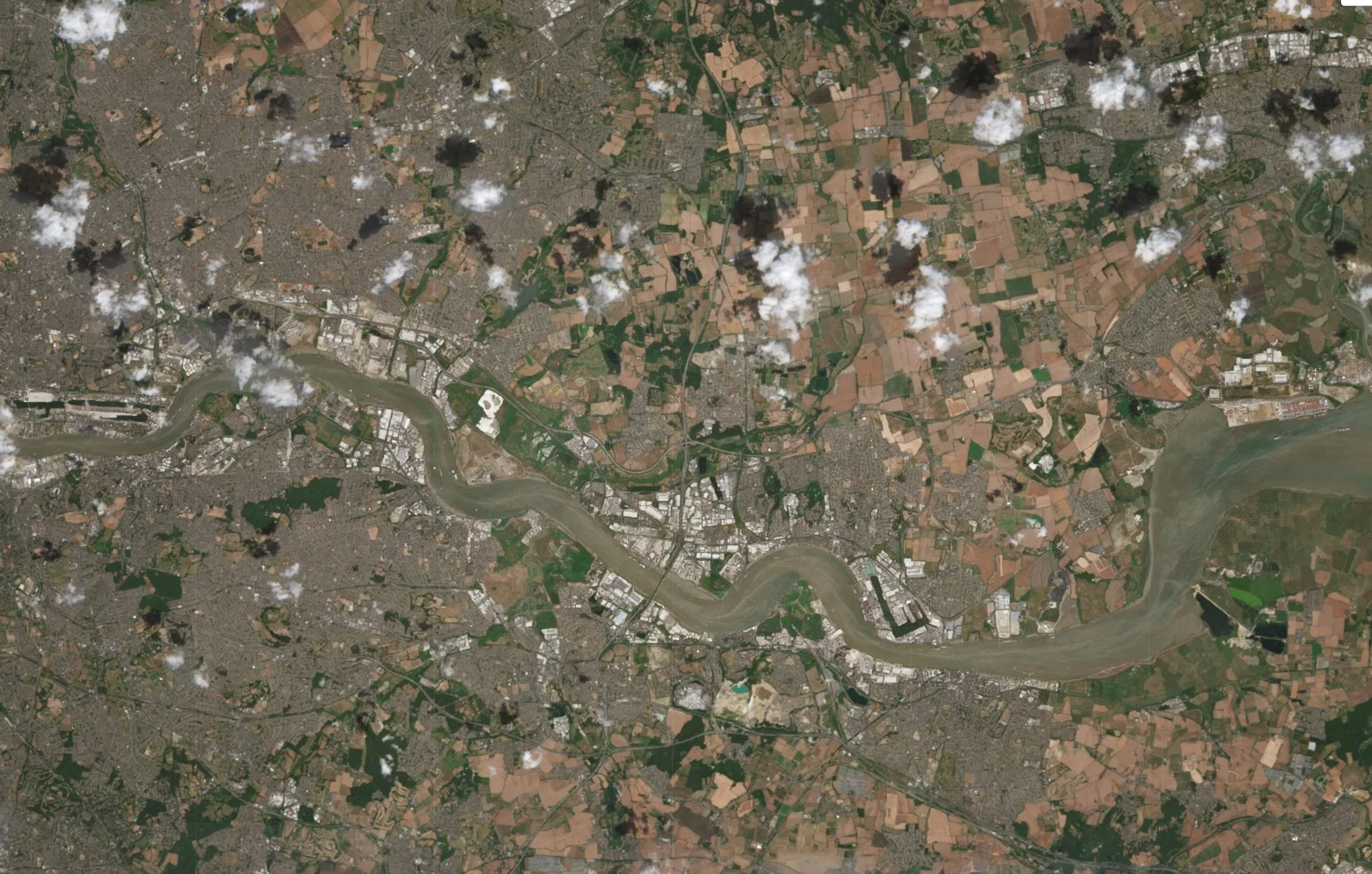
London Landscape Colours - July 18 -22, East London. 2022.
London’s clay is London dust,
Hush the red rose, hush the summer meadows green if you must,
Slating the land of our poems of olde,
Just what story are you being told?
I’ve seen it all before, broken fence posts like bones of a wrecked ship. Sirens, smoke plumes, helicopters. Now we stand at the edges of a firey outbreak in Greater London. You can see Dartford Bridge in the background and the stage view, near where my bags were laid to rest to take it in. A mosaic of dusty dryness, the scold of a fire scar with its wisdom of ages and the cosmos.
It is a lonely feeling, sombre, with a deep yearning and sadness. I get angry and scared about the pace this is unfolding and what continues to be left behind - I never knew I had such a love for England until I saw her green meadows burn away. It seems like a good time to include the words in a recent letter from Robert Adams - “but this does not excuse our role in the burning”.
To bring to light the scale and seriousness of what is being lost, over the coming months a number of ways you can learn more about what this summer looks like from the ground and space are being released. Please register or join our Patreon here to support the ongoing eco-critical research.
References:
Tom Waits - San Diego Serenade, from the album The Heart of Saturday Night 1974.
Earth Observation Images courtesy of NASA, ESA, & CEP
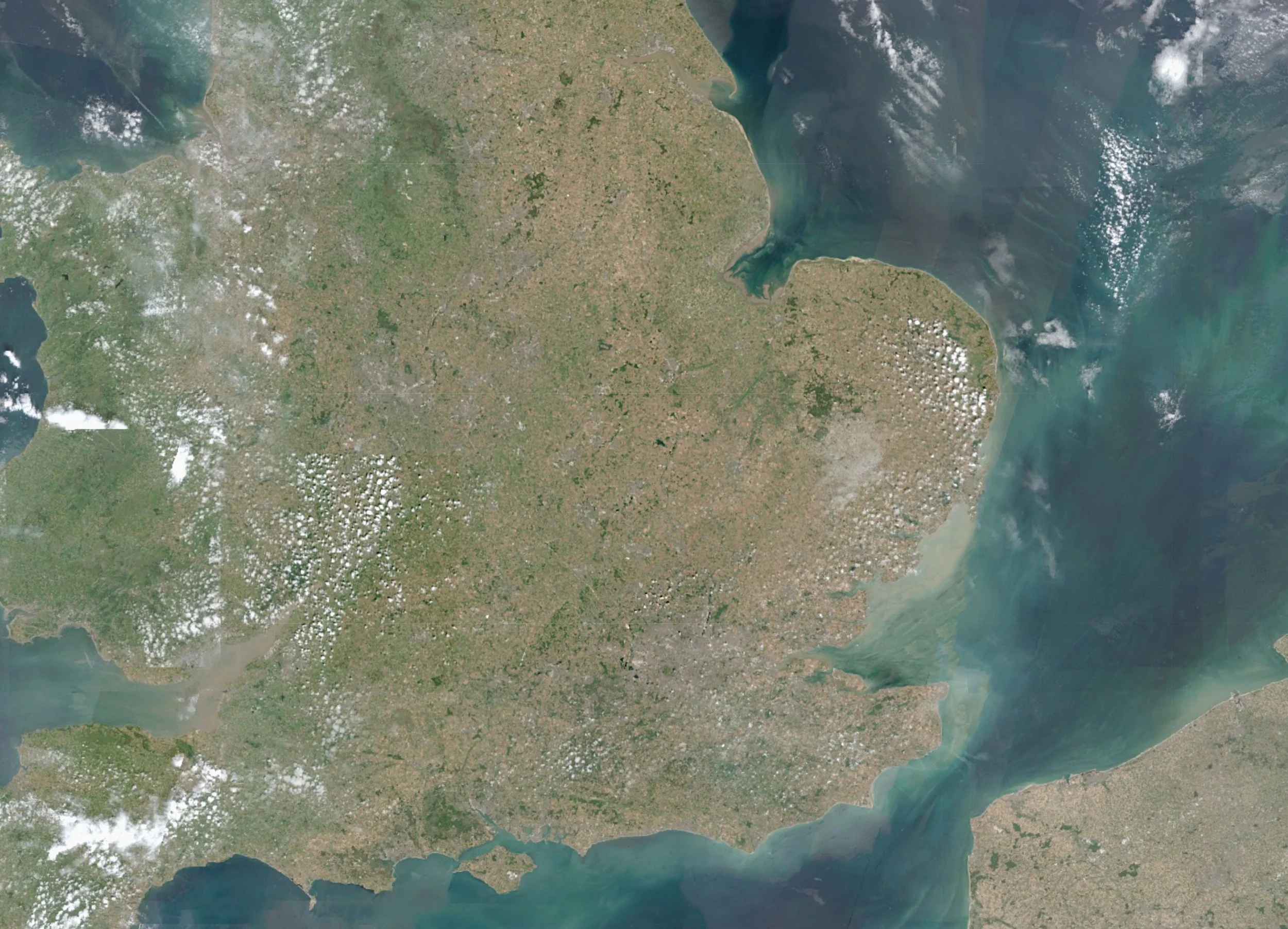
UK Landscape Colours - July 18 -22, Eastern British Isles, 2022.

Being Part of The [Fire] Conversation
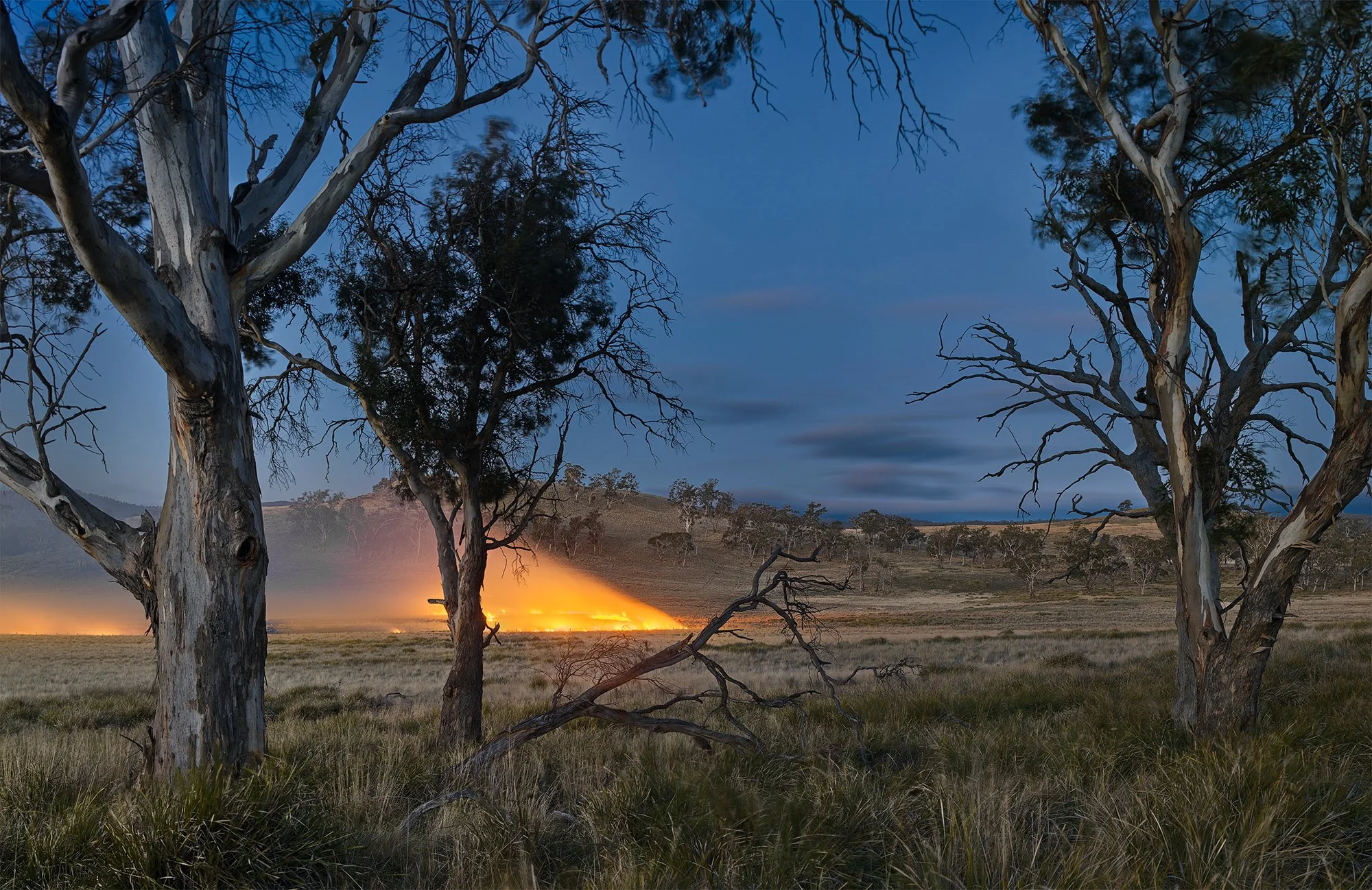
Fire Lines, 2019 © Alan McFetridge. Archival waxed inkjet Print 100cm x 125cm
Indigenous Australians have developed sophisticated relationships with fire over tens of thousands of years.
Click image for more of our study of Landscape Fire in Australia.
Whether by coincidence or planning, my first photographic studies of Landscape Fire took place in regions colonised by Europeans in the 16th &18th Centuries. With North America and Australia currently experiencing record temperatures and severe fires - links between dangerous fire behaviour and the transformation that invasive attitudes have had towards critical infrastructures such as water and biodiversity are drawn on in several articles for The Conversation - an independent source of news analysis and informed comment written by academic experts, working with professional journalists.
Please click the links below to learn more.
I was fortunate to have been invited into several regions by Indigenous stakeholders, Agriculturalists, and Fire Ecologists. The resulting photography is featured in the articles below to illustrate Fire’s dual capacity to regenerate, heal, and make abundant vegetation. This is also known as Indigenous Fire Knowledge, an effective system that has been displaced as have the people. It is time to act differently.
World-first research confirms Australia’s forests became catastrophic fire risk after British invasion
Link here
Our land is burning, and Western science does not have all the answers
Link here
Ilmu modern tidak mampu mengatasi kebakaran lahan; kita perlu belajar pada masyarakat adat
Link here
By Alan McFetridge
I want to acknowledge the Traditional Custodians of the land on which these pictures are made, where I stood and the pathways of the journey. These are Gadigal, Ngambri, Ngunnawal, Palawa and Larrakia Country. My gratitude goes to the Traditional Custodians for their continued connection to their lands and for caring for Country for thousands of generations. The Country visited includes Grassland, Mixed-Tree, Storm Burn, Gum-Tree, No Fire, and Desert all of which were observed because of their relationship to Fire Country. Across all of this beautiful Country there are many Sacred sites, the ones that were shown to me opened my imagination to the profound possibilities when place is allowed to dominates time. There were many other Sacred sites that I do not know their names or meaning, however, this is something I hope to understand and respect truthfully.
As the project grows a knowledge space has opened because of the sharing and openness of the First Nations people at the Tasmanian Aboriginal Centre and Northern Land Council to whom I pay my greatest respect.
Being a visitor, the warmth and understanding that has been shown to me has been overwhelmingly welcoming and gracious of my limited understanding of the customs and traditions that developed in accord with an Ecological Philosophy responsible for the oldest continuous culture on the planet. Each step is made knowing that the First Nations sovereignty was never ceded. This continent always was and always will be Aboriginal land.

Earth Day Reflections
In many ways, the end of the world would seem to be a fruitful vein for artists to explore, but as inhabitants of said world, there’s an argument to be made that exploration alone is not enough. As artists concerned with the climate crisis, it is imperative that we approach the work we do through a framework that centres not only the wellbeing of the planet we call home, but also the multitude of peoples whose perspectives are missing from institutionalised thinking.

I Am Weary of the Poets, 2017 © Alan McFetridge
Here at the Centre for Ecological Philosophy, this is a core tenet of our work. Alan McFetridge, Emma McLoughlin and Antoinette Johnson have recently submitted a paper to an academic journal on the theme of Landscapes of Care. The writing discusses Alan’s approach to photography through Martha Rosler’s framework laid out in In, Around, and Afterthoughts (On Documentary Photography) (1981), highlighting the need for positive care for photographic subjects, as opposed to the historical tendency of documentary photographers to capture the pain and suffering of their subjects before promptly moving on. Alan subverted this tendency while shooting for Songs of the Dead by working with the community of Fort McMurray to more accurately represent and reflect on their experiences in the aftermath of the Horse River fire of 2016.
This shift away from the historical norms of the genre is representative of a larger shift in the mindsets of artists covering the topic of the climate crisis, from which we can gather hope. As the planet’s changing climate looms larger in everyone’s minds, there is great progress being made in the field of ecological art. Artists are responding with empathy, bringing attention to the plight of the vulnerable and challenging the systems of power which seek to exploit them and the Earth’s finite resources.
Share your #ClimateAction this Earth Day
As climate Action is a year-round undertaking, throughout Earth Week (19-22 April) we are calling on everybody to share examples of the #ClimateAction they’ve been taking over the past year. Tag us on Instagram and Linkedin so that we can re-share on Earth Day!
Happy Earth Day, everyone!
By Oscar Cannon

Fire from a Different Perspective

Four Sheets in the Wind, 2022, © Alan McFetridge
Have you ever wondered what a fire looks like from space? My name is Eriz Yusuf and part of the newly established Earth Observation initiative. With coworkers Mohammed Mazy and Thomas Lanning we are investigating the dual capacity of fire, as a regenerative power and to reveal the scale of the global fire crisis in regions such as the boreal forest, the world’s largest woodland. For the past 6 weeks, we have been applying our Data Science background with space technologies to explore fire from above the atmosphere.
We aim to offer clear insights for policy and risk assessment about the effect of fire and smoke by working on the ways imagery can impact the wider relationships of ground ecology positively. At first, we are showing low resolution to medium resolution to clearly determine burn areas and atmospheric conditions. These four views represent the early stages and a glimpse of what is to come!
By looking at the boreal forest our vision is to complement the groundwork of Alan’s upcoming monograph Songs of the Dead.
We are excited to share more information, if you would like to ask any questions you can do so here.
By Eriz Yusuf and edited by Alan McFetridge.
Code by Eriz Yusuf, Mohamed Mazy, Thomas Lanning & Image by Alan McFetridge
For more information about Song of the Dead, please click here

Two More Seats at the Table
How have you been enjoying the recent appearance of some good ol’ British sun? Recently at the studio, we’ve finally been able to enjoy some al fresco lunches, joined by a lovely neighbourhood black cat (yes, we’ve already thought about adopting her as the resident studio cat).

Firegram #1, 2016. Limited Editions of 6 Prints plus 1 x AP
Pigment Ink on Waxed Archival Paper. 58cm x 77cm
It’s a pleasure to welcome two new team members who have settled in at the Centre for Ecological Philosophy (CEP) this week. Data scientist Mohamed Mazy and photography assistant Igor Augustynowicz. Their interest in doing good is aligned with everyone here and expands our capacity to independently create, communicate and contribute to eco-critical debates.
Mohamed is currently pursuing his interest in AI through a master’s degree, alongside working with Eriz on the Earth Observation project. He will be processing satellite data to devise visualisations of landscape fire from up high.
Igor has a background in international politics but also began taking photographs in 2020. He will be working on the development of the upcoming monograph Songs of the Dead as well as creating a series of mini-documentaries on local ecology.
You can check out the full team here
We’ve been diligently working on ways to engage our audience more, so, unlike this bout of British sun, we will not be disappearing any time soon. Stay tuned for updates on Songs of the Dead and the perks of becoming a centre member through our Patreon
Limited editioned prints of the leading image on this post is available to purchase now at Alan McFetridge Photography Store.
Take a stroll with us: walking without a camera

Hillock of Robin Hood Gardens. December 2021© Alan McFetridge
When was the last time you went for a walk without a camera?
Not just any old walk, but a contemplative jaunt. One for yourself and your thoughts and a way of seeing and feeling your surroundings.
This week we welcomed some more team members to the studio (more coming soon!) and we began our introductions with exactly this. Alan calls it “walking without a camera”; and so as a photographer turned charismatic architect tour guide, he led the way.
We meandered from Bromley-by-Bow towards Canary Wharf, stopping at Balfron Tower and Robin Hood Gardens, reflecting on the history of these buildings and places. Displacement was a big theme in our discussions and the effect of this on community and the value of buildings, particularly noticing the contrasts in the kinds of building work occurring and the rapid changes over the past half-century. Even amongst all this change, however, there is pride in origins and place. As Sandra Chalmers, Chair of the Brownfield Estate Board in 2015, eloquently says:
This is “a community that looks out for one another, that shapes and influences and regenerates, all to re-make our estate as the place we are proud of, want to live in and which brings us together in ways we made happen”
(Foreword from Sunday Best, 2015)
I personally really appreciate this encouragement of allowing time to let an idea emerge. It is a useful approach at the beginning of a project like each of us are undertaking, as it is not often we are allowed to take that time. Too often we are bombarded with stimulation and told to rush headstrong towards a goal.
So, as the finer weather of spring is just around the corner, why not try taking a walk without a camera yourself to see what you can discover in your own area. We would love to hear your experiences if you fancy sharing too!
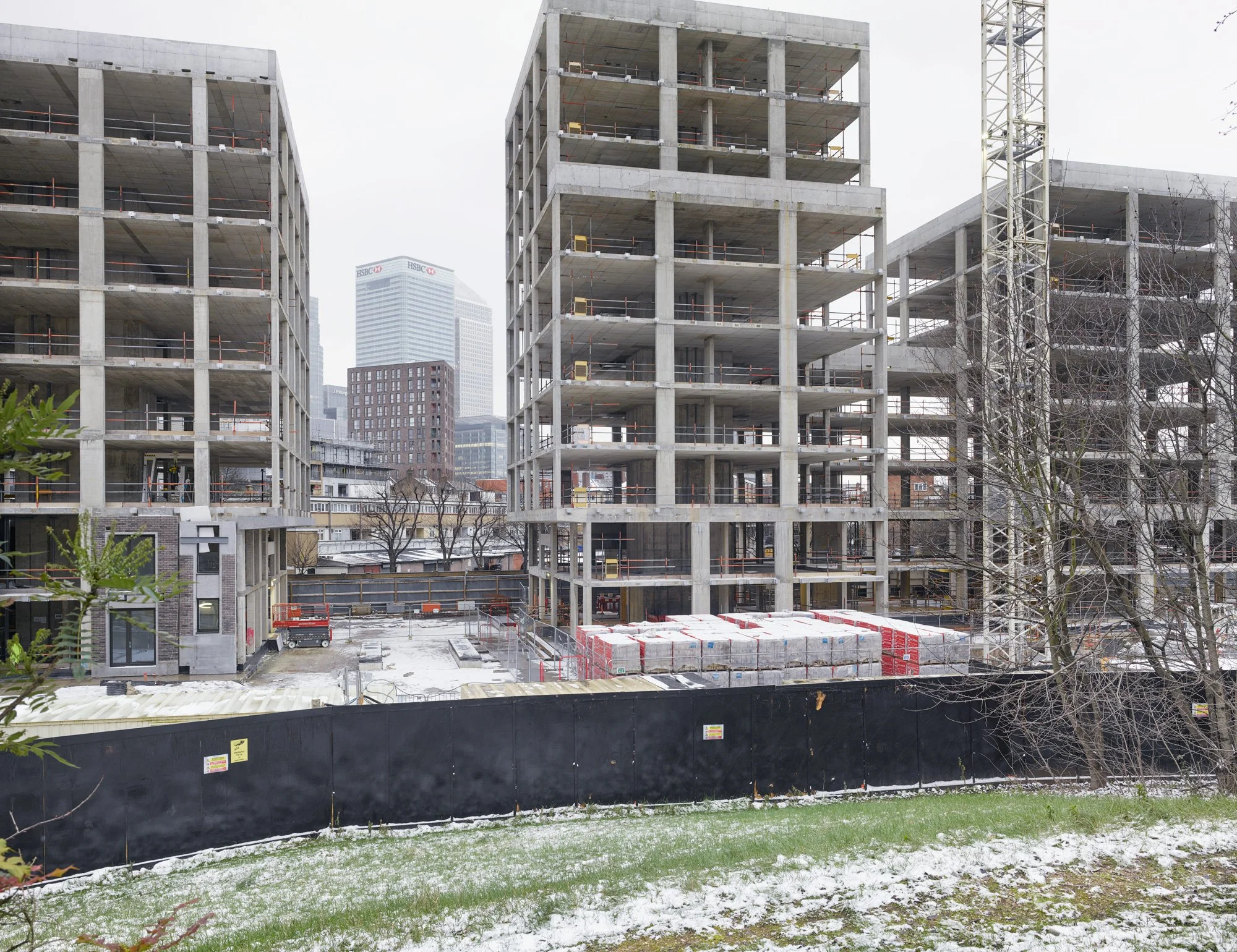
Westerly view from the Hillock of Robin Hood Gardens. December 2021© Alan McFetridge
Read on for some thoughts and reflections from the group:
Igor Augustynowicz
"It was lovely to get a feel for the place we’re working in – it isn’t just a studio in an industrial estate, it has its own history that’s valuable to appreciate. We had a very relevant conversation about the ambitions of famous architects vs. the realities of those living in their buildings. It’s something to keep in mind when working on documentaries, does our work serve people or just our artistic impulses? Also, it’s nice to just get out for a walk, really."
Oscar Cannon
“I think the walk was a brilliant opportunity to get out of the studio and spend time together as a team. It was great to learn more about the local area and it helped to understand the wider context of the projects we are working on.”
Mohamed Mazy
“Since developing my interest for data science, I always thought that I would work in different fields but never for the good of the environment. Despite that I have some ecological values, which I think today's society sometimes pushes us to put aside. I am glad to have met my new team during this walk and to have seen that they are as motivated as me to be an actor in this work.”
Eriz Yusuf
“I am really excited to be a part of this team, we are from a range of different backgrounds and I'm really looking forward to working with everyone and hopefully making some great new friends in this team.”
Warmest regards
Emma Mcloughlin (she/her)

The Team Continues to Grow!
Did you know that more diverse workplaces foster more creativity and innovation? That is why Alan has been working hard to build a team of researchers and artists from a variety of backgrounds and experiences to create and innovate at the studio!
Did you know that more diverse workplaces foster more creativity and innovation? That is why Alan has been working hard to build a team of researchers and artists from a variety of backgrounds and experiences to create and innovate at the studio!
Over the past few weeks we have welcomed three new members to the Centre for Ecological Philosophy:
Data scientist Eriz Yusuf will be using satellite imagery to investigate fire from space
Anthropologist Emma McLoughlin is working with the community in Fort McMurray to include their perspective on the visual culture of Fire
Photography Assistant Oscar Cannon is working behind the scenes on the production of our upcoming monograph Songs of the Dead, and in front of the scenes on upcoming photography projects!
Visit the About page to learn more about our new team members!
It’s exciting to see the centre growing as we continue to work on Songs of the Dead. Speaking of which, you can find out more about our progress at this dedicated page. Get a glimpse into Antoinette Johnson’s essay So-Called Canada: Finding an Anthropocentric-Biocentric Nexus in Fort McMurray; read about Emma’s current findings in her Anthropological study; as well as other updates in the pipeline.
In the coming weeks we will be adding even more researchers and artists to the team! As we wander along the path of creative uncertainty, stay tuned to see what we accomplish together.

Infinity (Working Title), 2019. © Alan McFetridge