
Dis/obedience to the Earth - Now available as a podcast!
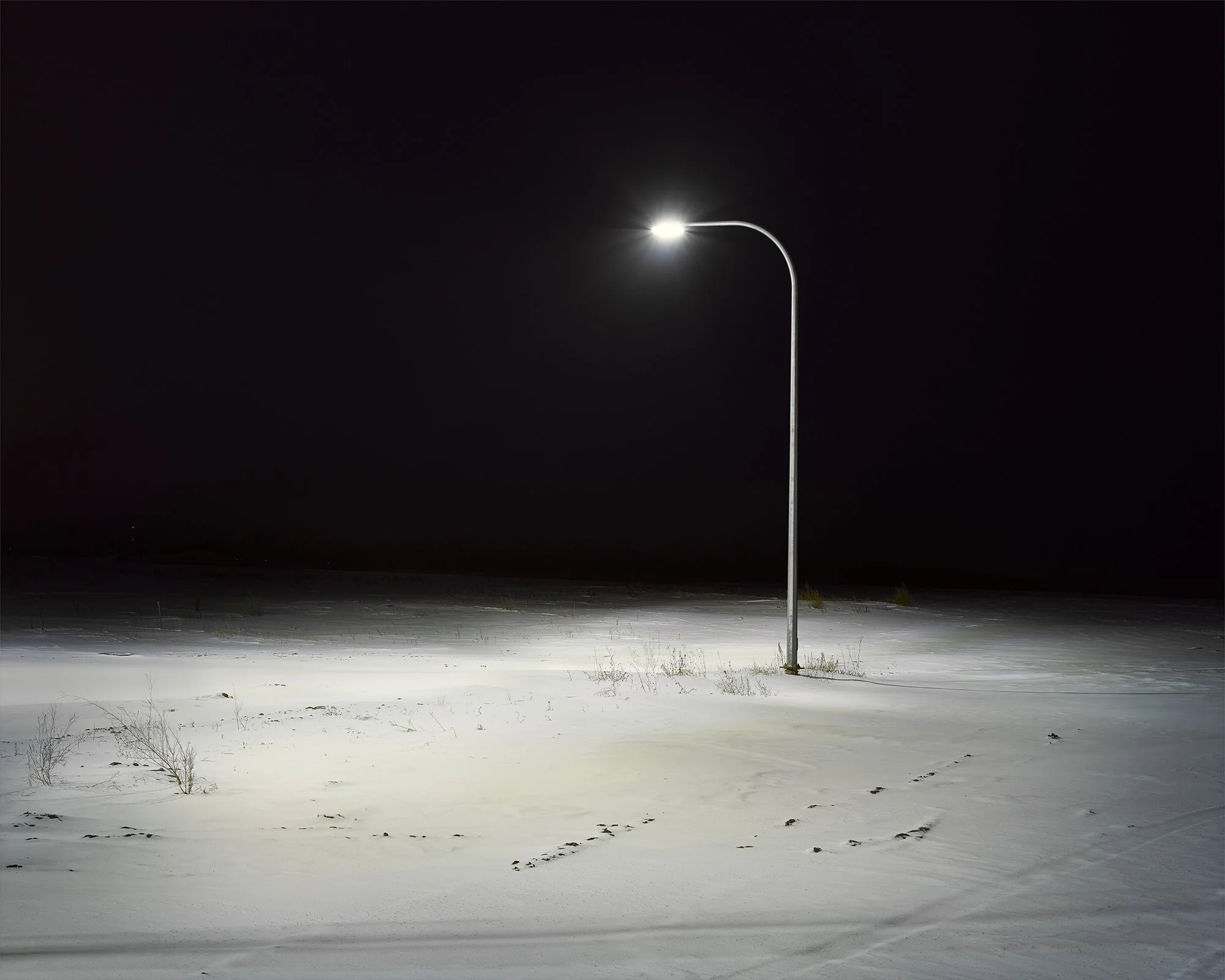
In One Form Upon This Earth, 2017. 100cm x 125cm © Alan McFetridge
A while ago, probably long enough for some of you to have completely forgotten that it happened, Alan was invited to talk on a panel event at the University of Westminster on climate awareness. We promised that for those who were unable to join, there would be a link available so that you can listen to the recorded version. Well, my friends, your prayers have been answered!
Thanks to the handy work of David Morris, this event is now available on a multitude of platforms and you will not regret taking just an hour out of your day to listen to an intelligent and engaging discussion of spirituality and climate change.
Dis/obedience to the Earth - A Climate Awareness Panel Event for Interfaith Week 2021 is available on Breaker, Google Podcasts, Pocket Cast, Radio Public, Copy RSS, and Spotify! Click the link below to listen!
Fun Fact: ‘Dead End Days’, a serialised dark comedy about zombies released from 31 October 2003 through 2004, is commonly believed to be the first video podcast. As a side note, Alan’s upcoming monograph, currently titled Songs of the Dead, was previously called ‘Dead End.’ There is, however, no similarity between ‘Dead End Days’ and ‘Dead End’ … or maybe there is? It’s actually about Zombies…
East London Superlab | NOW OPEN
For months now, we have been working away at the studio and on the website because we wanted to meet everyone for last night's launch event for the East London Superlab all set to go. The idea to share the resources and workflow sparked about 12 months ago during the lockdown and finally the day arrived - and to our delight there were many libations for friends and the beginning of the East London Superlab.

Above: Print Studio
So firstly and most importantly - a great night is normally because of great friends and the opening did not disappoint! Thanks to those that came to mark the occasion - all together. Also a special mention to our Patreon members too - thank you!
As of the 28th of January the East London Superlab is now open; in the studio and on the website. We welcome those interested in inkjet print making, in art, ecology, or whatever sparks your fancy!
You can read much more online about how to order or book studio time online. Please call or email if you have any questions about East London Superlab and all the other work taking place at the studio from book making to space technology or if you're interested in joining the Centre for Ecology, take this as your opportunity to introduce yourself.
Our very best wishes,
From everyone at the East London Superlab and Alan McFetridge Photography.
We are Hiring: Six New Roles for Ecological Research and Photography
We are excited to offer six new Kickstart Scheme Roles for 2022 for six months each. These positions will give the successful applicants the opportunity to work on ecological research outputs in the Arts.
6 new temporary roles are available for 16 -24 years olds* Open Applications until 14 February 14 2022.
Outline of The Roles:
Junior Data Scientist - Computer Science x 2 open roles
As Fire on Earth continues to find new extremes we are looking for people to work collaboratively with satellite data to investigate how fire is seen from space.Photography Assistants x 2 open roles
We are currently producing fine art prints, a monograph and compiling recent field studies from Australia and Greece. These roles will involve using Adobe Creative Suite, Squarespace, Capture One to move each of the areas forward as a collaborative team.Marketing & Communication Lead x 2 open roles
This is a role for an organised person that can understand the broader vision of the group and see the necessary detail of daily studio life and develop a marketing plan to include articulate writing, social and physical networks and coordinated logistics and communication.
These are ideal roles for anyone who wants to put their energy on Ecology in a fast-paced, highly collaborative, visual and data-driven environment. Someone who is thrilled towards gaining exposure to the multiple facets of creating visual art to thrust and be present in eco-critical debates. Including operations, product development, logistics, fabrication, sales, marketing and research. The team has an ardent sense of the value that a committed group has in expanding environmental knowledge through field work, theory and output.
The right candidates from diverse fields and backgrounds are very welcome as the ability to focus, enjoy your work, learn fast, intuitive, complete tasks and think laterally is viewed as key skills. We’re looking for team members that excel across the entire development lifecycle, come with a growth mindset, and bring a genuine desire to learn about ecology and how to communicate this.
The studio is in East London 8 minutes walk from Bromley by Bow station. Wheelchair access is available to the ground floor, however the studio is on the first floor with step access only. Happy to look at solutions to work off site or discuss possibilities with the building owners to get first floor access.
Landscape Fire Research
Photography Book Production
Earth Observation
Visually lead with an emphasis on publication and exhibition.
East London Studio Location
Details:
Kickstart is a scheme for 16-24 year olds who are unemployed and on Universal Credit. Eligible applicants need to speak to their own JCP work coach who will be able to make the referral.
Please direct any questions or send CVs and covering letters to alan@alan-mcfetridge.com
Open for applications until 14 February 2022
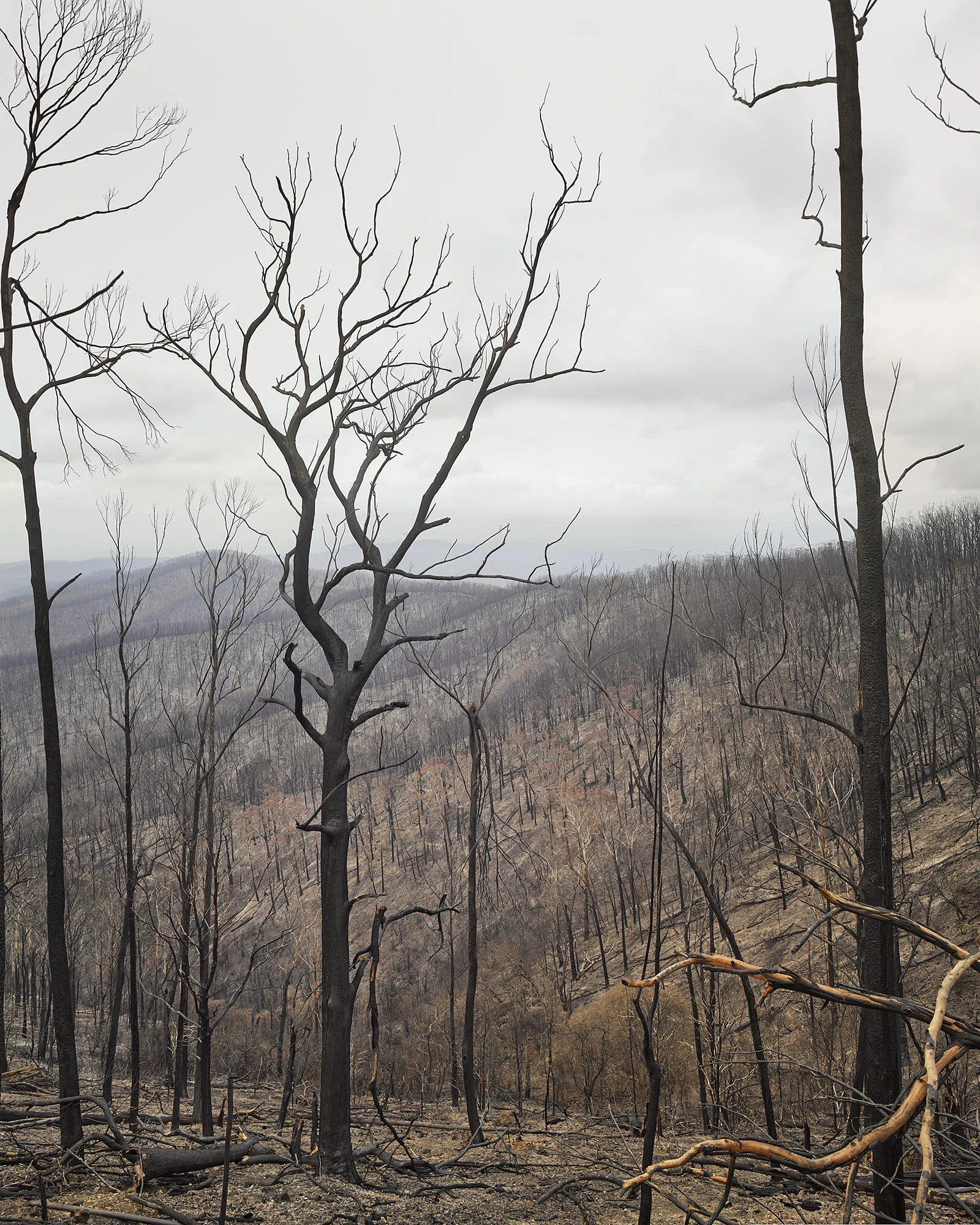
Tears in Silence, 2020 © Alan McFetridge


Special Announcement | East London Superlab | Launch Event
We are very excited to be hosting a launch event here in the Superlab for you to come to check out the space, learn more about what's on offer and just generally have a good time! There will be wine and cheese for everyone.
Who is welcome: Everyone! artists, photographers, collectors, print enthusiasts or anyone who wants to chat ecology or print or both! This dynamic and social space welcomes all.
About Us
The East London SuperLab is a dynamic digital printing service with humble beginnings, inspired by Alan's darkroom and inkjet initiatives in the early 1990s until today. Set up in the heart of the Alan McFetridge studio, ELS will help artists and photographers realise their work into print. ELS supports eco-critical debates and action in a socially dynamic studio space.
The superlab will offer a range of services, curated to suit anyone who seeks to fine prints, regardless of their current knowledge or expertise. The three services are as follow:
The Print Room Service
Set up to cater to individuals who want to be completely involved in their own printing process, this service gives you full access to the ELS equipment and a social, creative space to develop your practice through print.
Self Service
Similarly to the Print Room, Self Service allows for flexibility, quick turnarounds and costs that reflect a more self-involved process that supports the complete customisation of your artwork. All you’ll need to do is prepare your print and send it to us. Easy!
Custom Printing
Alternatively, if you require more assistance and guidance, custom printing is a one-to-one relationship with an experienced printer to manage and handle the journey from a digital negative to fine print.
Our website page will feature more information on how to use the different services, upload your files, how to book them and will be available from the opening on the 27th January!

As We Trek Forward | A Festive Note From The Studio
A festive note from the studio as we trek forward towards the new year through the festive season.

I am Indeed a Ghost, 2017 ©Alan McFetridge
Hoping this finds you well, warm, and in good spirits.
Alan and the studio team in East London would like to send our warmest wishes to you and your loved ones for this holiday season. With the many challenges being thrown our way in the last few years, we are discovering more and more the importance of hope as we look to the future.
Looking forward to what the New Year has to offer for all. Until then keep well and safe.
Our very best wishes,
Alan, Antoinette and Connie
by Connie Boeree

Whose Responsibility Is It Anyway?
Antoinette Johnson writes about the UK and climate change, questioning, who’s responsibility is it anyway? Accompanied by photographs from Alan McFetridge.
As a group operating in Britain, we feel it necessary to respond to how the Climate Crisis is discussed in the news because this is how a large portion of the public are able to interact with Climate Change discussions. Roger Harrabin, a BBC environment analyst, published an article 6 days ago titled : COP26: UK 'nowhere near' meeting targets agreed at Glasgow climate summit.
According to this article, “The Climate Change Committee (CCC) says that, at current rates, the UK will be contributing to a disastrous temperature rise of 2.7C by 2100.” To combat this problem, Harrabin has the audacity to explain that “It maintains that the government must nudge people towards greener lifestyles, and must tackle emissions from farming more aggressively.” To place responsibility on the British individual to make lifestyle changes is, on the one hand, expected and useful, but on the other hand, ignorant and classist.
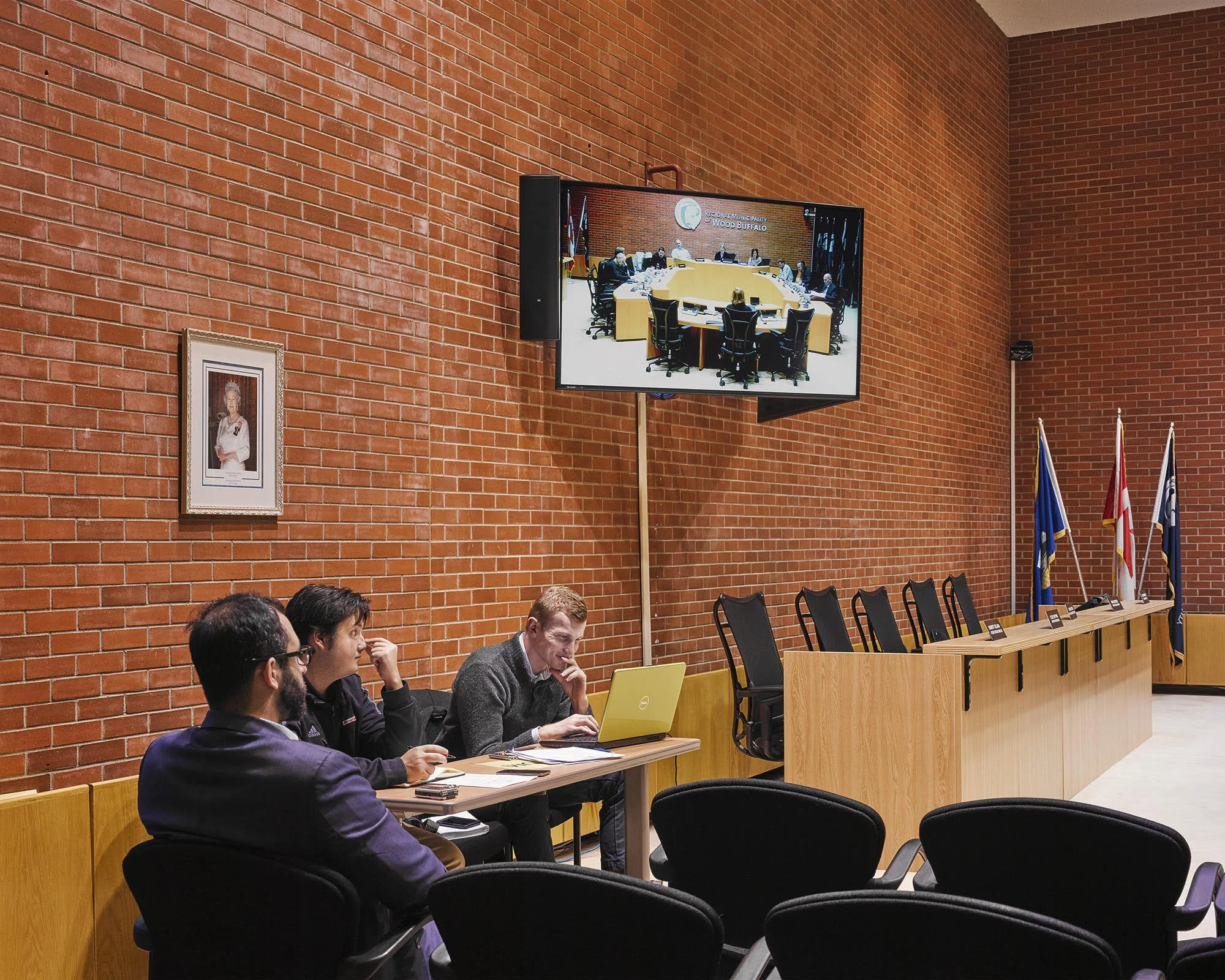
Inventors of New Values, 2016 © Alan McFetridge
Chris Williams, author of ‘Ecology and Society’, writes that current responses to the climate crisis show that “the gap between ends and means is so absurd as to be laughable”. He continues “much of the environmental movement in the North [sic] is consumed by arguing for ordinary people to make sacrifices in order to save the planet.” Such an argument “speaks to and for a very narrow segment of middle-class opinion formers” as opposed to addressing “socio-ecological justice for the world over”. What this means is that climate change cannot be dealt with by individual ethical choices alone and the reality is that this sense of responsibility on the individual is ignorant to the circumstances in which many people need to survive, let alone thrive.
Refusing to purchase bottled water (especially those made of plastic), buying local, vegan diets, installing solar panels, electric cars, second-hand clothing - none of this will be enough. Yet we are expected to make these changes and criticise others for not doing the same which seems to me only another example of how the elite get us to fight between ourselves. Vegans telling non-vegans to be vegan; cyclists promoting cycling. It’s always good to live a greener lifestyle; to bear in mind our contribution to global warming. But what would be more effective would be to challenge leaders who continue to fund environmentally destructive projects, who make it difficult for citizens to live sustainably because it is unaffordable for many. To reach these targets we can remind large corporations, governments, and billionaires of their responsibility.

A Riddle is it Still this Dream, 2016 © Alan McFetridge
Therefore I pose an alternative responsibility to the reader instead. Not everyone can afford to live sustainably, it’s fashionable, expensive and a trend of the white, middle-class. We need not argue with our peers and friends over how green our lifestyles are and we need to stop falling into a trap laid by the privileged because the Government can, however, work harder to make a greener country. We can repurpose this energy we have for calling out our friends when they aren’t acting green enough and target it elsewhere - toward those in charge. They can afford it, they have the power to change it, and they can, in the process, improve the average quality of lives of the British public and beyond.
Warmest regards,
Antoinette Johnson (any pronouns)

“Survival of The Fittest”
“Survival of The Fittest”: An Introduction Into The Interconnectivity Between Society and Ecology by Antoinette Johnson
“Survival of The Fittest”: An Introduction Into The Interconnectivity Between Society and Ecology
I am currently writing an essay to accompany Alan’s photography in the next monograph and, as you can imagine, I have to battle the excited urge to include every piece of thinking that makes up the text; pages and pages of “Antoinette’s thoughts in no real order” do not exactly make for the best piece of writing. Luckily, there’s a blog for me to express those thoughts in and so this blog post includes an idea which, while essential to the thinking informing my text, will have to be cut from the essay to improve the quality of the writing. Luckily, it also gives you a sneak peek into the essay!
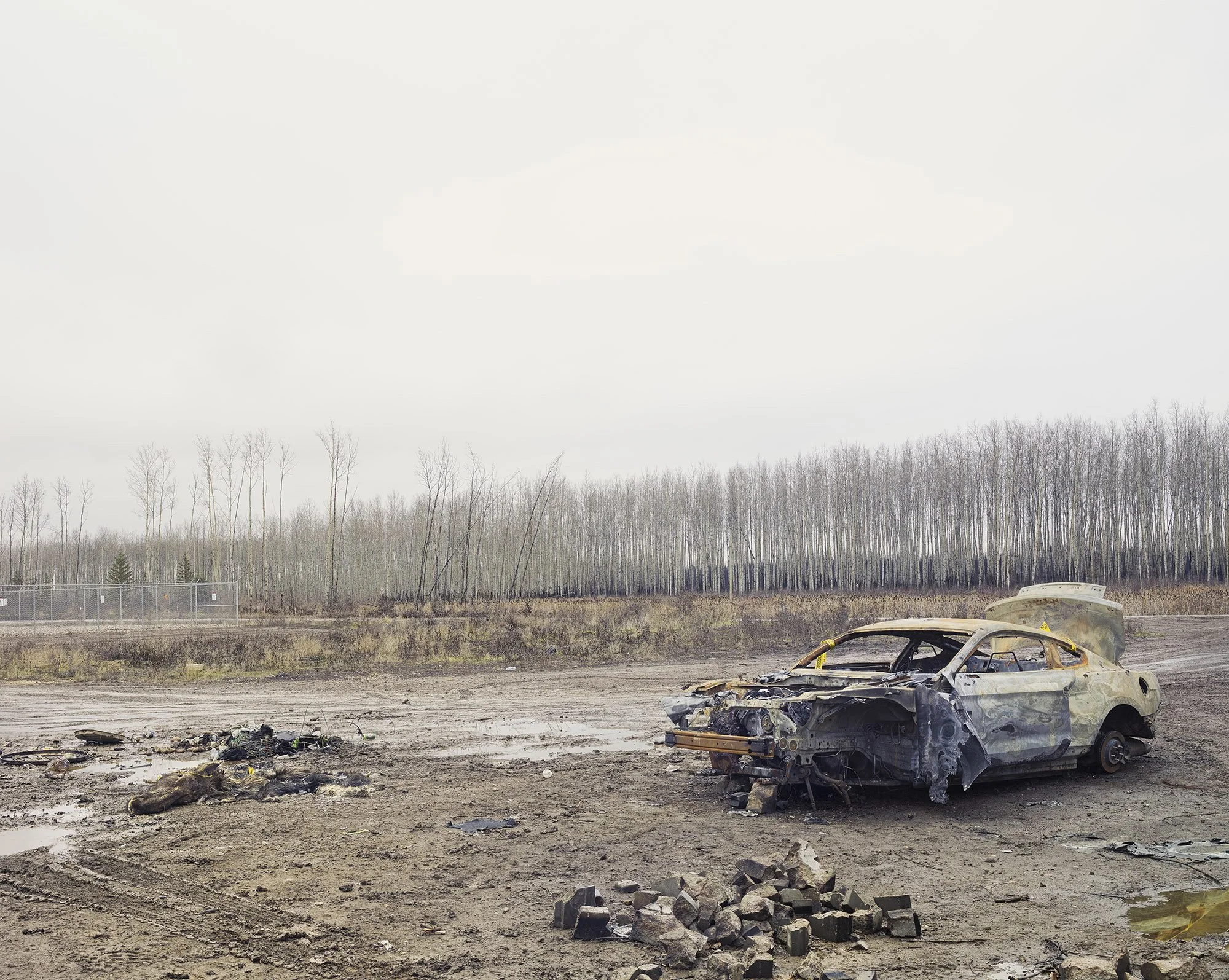
Crossing the Lands, 2017 © Alan McFetridge
Scientific ‘development’ has certainly left its mark on Western culture and society. One of the most influential Scientific theories is, of course, Darwin's theory of Evolution. In its most basic sense, the Darwinian theory proposes that lifeforms on Earth regularly overpopulate and are in a constant state of inter and intraspecies competition. As a result, random genetic mutations producing favourable characteristics increase the chance of survival and after a long period of mating and reproducing this genetic mutation in offspring, the weaker or less-adapted individuals die out. This theory promotes a worldview that is entangled in competition, conflict, and domination and has had a myriad of social consequences (including the modern application of socio-economic institutions). Darwinian Evolution justifies human dominance over the Natural world, constructs the hierarchical “ladder” mentality that has so often been used to promote a ‘survival of the fittest’ in noxious social contexts, and indicates that indigenous communities all over the planet are in some form of primitive state with White ‘developed’ civilisation at the height of intellect and evolution. This approach to Darwinian theory is explored in detail in Robert Lawlor’s Voices of the First Day, a text inviting the reader to reimagine the Earth within the context of Australia’s aboriginal communities’ Dreamtime.
Evidently, there have been social consequences of Darwinian theory. Concepts of evolution have been used to justify eugenics, social (and often Racial) subjugation, and worst of all the concept of socio-economic “survival of the fittest”. Darwinism was informed by its social context, that of Victorian-era politics and traditions, and by participating in the wave of social change appearing within this era it constructed a new doctrine that has regulated Western thought. Transitioning into Fort McMurray, the primary case study for my essay, this Urban Service area is a place where many of the inhabitants have migrated to so that they might survive within Capitalism’s ‘Survival of the fittest’. This area makes evident the deep connection between society and industry in the wake of Darwinian “Survival of the Fittest”. The impact of Darwinian theory on the progress of Capitalism is unquestionable. This is because supposedly opposing forces such as Science and Culture, Society and Industry, Environmentalism and Economics are not so easily separated. In fact, they are completely entangled with each other. In light of this, ultimately, we can explore just how interconnected our approach to Climate Change needs to be in order to begin to fully understand the disaster at hand and realise that our current mode of existence is dangerously socially, environmentally, and globally unpropitious.
Therefore, much of my essay is dedicated to dismantling the dichotomy between social criticism and ecology for, arguably, ecology must include social criticism in order to fully encapsulate the complexities of the crisis at hand. A crisis caused by Western culture, thought, phenomena, and all in a present so heavily defined by an exploitative (then finding ways to justify that exploitation) past. Through an investigation into the social consequences of contemporary scientific language, and the social structures informing the operation of institutions, we can make claims regarding the interconnectivity between society and ecology. Inevitably, the way in which Western societies function is an integral part of their Ecology, therefore proposing that Ecology is a discipline that does, and should, include applications of the sciences within an awareness of institutions, rituals, practices, education and social responses to climate change.
Warmest regards,
Antoinette Johnson (any pronouns)

Raising Awareness: What Works, and What Doesn’t?
Inside scoop on Alan’s panel talk on: Climate Change Awareness: What Works and What Doesn’t?
I often find that distinctive or various disciplines consider themselves to be in competition with another. If not in competition, then convinced that one is right while the others are wrong. The same can be said for some individuals of differing faiths or spiritual beliefs but at Westminster University’s event ‘Dis/Obedience To The Earth’ Alan had the privilege of participating in a space where there was no rivalry or contention, instead there was responsiveness, understanding, interest, and companionship across the different faiths.
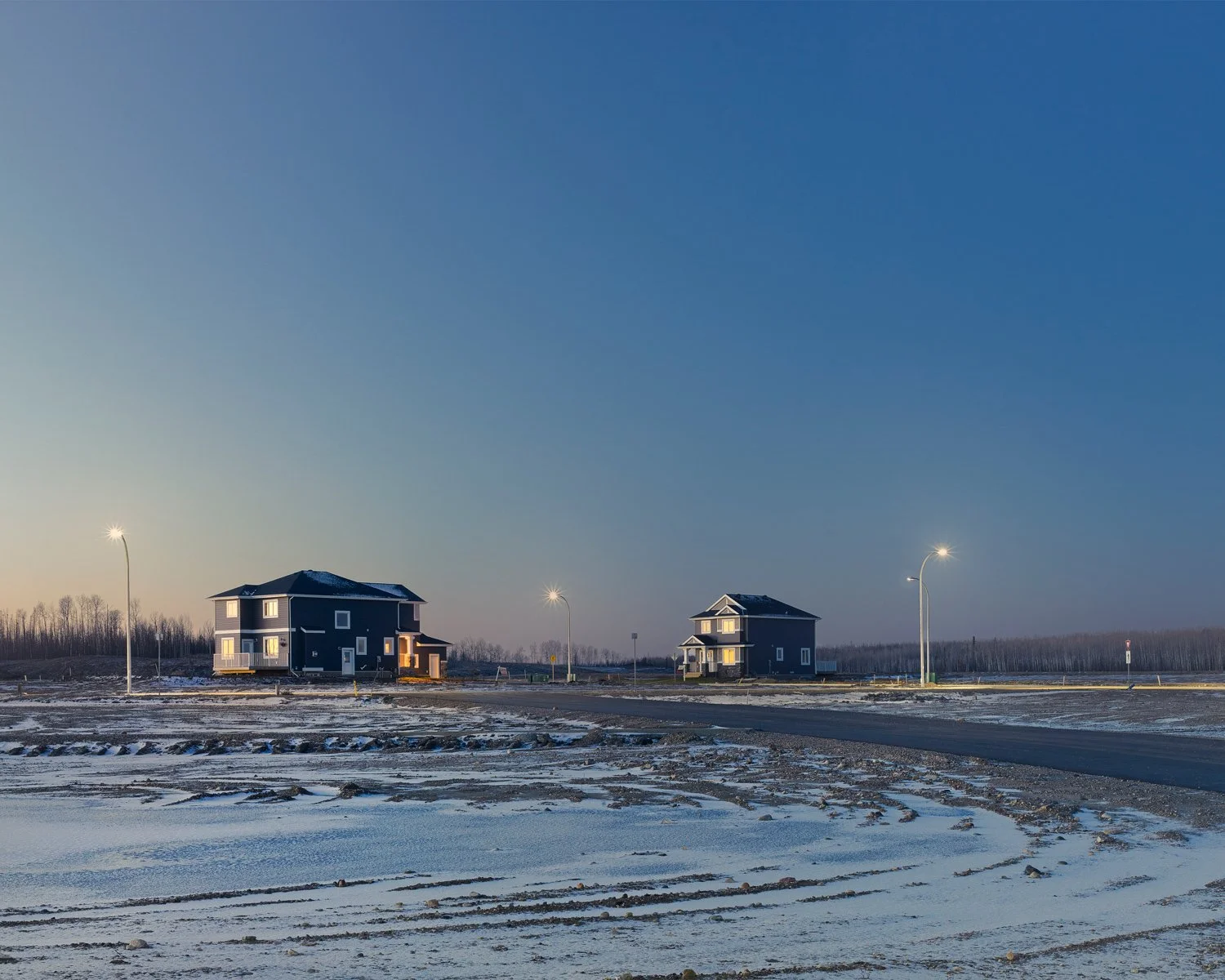
Know Your Own Species Best, 2017 © Alan McFetridge
Overall, Alan returned to the studio having learned about how Melanie Nazareth (Christian Climate Action), Mothiur Rahman (Muslims Declare), Dr Jasdev Rai (Sikh Human Rights Group), and Katja Behrendt (XR Buddhists) have been dealing with the Climate Crisis within their faiths and/or communities. Some of the responses took a more head-on approach, discussing how Christianity, for example, shows Jesus protesting for what he believed and how we, therefore, can do the same. Others were more class-critical, proposing that the Climate Crisis is a crisis for the rich, elitist West and not for all global communities. This summary can never, of course, do their work justice and therefore I look forward to informing you when a recording of the event will be accessible for the wider public. In the meantime, below is a passage written by Alan concluding, in brief, some of his contributions to the talk.
-
What doesn’t work? Fear …. human behaviours are very much unlikely to change when problems are presented in ways that raise fear and anxiety. This is likely to cause division.
What does work? Hope … human behaviours can change and incredible feats become accomplished. Hope creates unity.
Blind hope however is not enough, I’ve found that having a clear vision with action is essential to remain focused and positive. This is why I see the value of establishing a role for ecological philosophy to guide sanctionable modern laws to protect the rest of nature. Because as poet Znignew Hebert writes - How can we live anywhere but under this one tree.

The Heart of Earth is Gold, 2017 © Alan McFetridge
Overall, we enjoyed this collaboration and hope to be involved in far more events in the future. We are also planning out some events we might like to host as part of The Centre for Ecological Philosophy so keep a look out for future announcements! If you want to get involved or would like to invite any one of us to your talk, lecture, gallery, or anything that you think might spark our fancy, get in touch!
Warmest Regards,
Antoinette (any pronouns)

The Centre for Ecological Philosophy
Antoinette Johnson writes about The Centre for Ecological Philosophy, hope and the power of ideas…

Remnants of a Golfball and Bugs exposed to heat from the Megafires across South Eastern Australia during 2019 - 2020
Once, I sat in my room (probably mid mental-breakdown but that’s not the point) discussing the end of the world with two of my closest friends. I had a generally defeatist approach to the climate crisis, politics, economics, and anything to do with life currently. They, well one of them more than the other, weren’t so …dejected. Rather than accepting my pessimistic and somewhat realistic statements, she pressured me to hope that current action can, and will, be a driving force in the wave of social change underway. She made it clear, however, that the people who desire such a change must work together and use their skills to contribute to that cause. Including me.
Social movements are not rigid, they are constantly in conversation with themselves, evolving, thinking, acting, and all the while we need spaces to be able to have those conversations openly, to challenge ourselves and each other, to plan our actions… to prepare to “take arms against a sea of troubles and by opposing, end them”. Except, where many of us are faced with a million obstacles at every point, it can be difficult to feel that we have any real control. Those who support protests and social displays of the ‘enough is enough’ are restricted by laws. Those who challenge convention are faced with choosing between compliance or poverty, abuse, and criminalization. Some of us want to make art, or literature, or just be in the room but it can be awfully intangible. Sequentially, disappointment can make one feel like sleeping is quite honestly the better option.
Sleeping is not the better option.
It’s a really good option but it’s not exactly the most effective.
The thing is, we need a space to explore our skills and use them to the advantage of a movement that we want to be a part of. Therefore, we need a Centre for Ecological Philosophy. In essence, this is both a physical and intellectual place for people to work collaboratively on expanding their understanding of the climate crisis and generate solutions or just keep oneself present. Alan has a vision for The Centre and this vision managed to give me the opportunity to conduct research and write outside of an Institution.
Having seen Alan interact with a vast network of creatives and intellectuals, I’ve witnessed how valuable collaboration is and how it can push us to work harder or challenge us to think outside of what we thought we knew. Access to different perspectives is an essential part of tackling our own ignorance and allows us to make better, well-informed choices whether that be in the size of our print, the phrasing of a sentence, or the inclusion of another methodology.
The friend I was speaking about is an Italian Cultural Geographer and Literary Critic, a writer of both fact and fiction, she too would probably love to be in a space where she can use her unique perspective to participate in Ecological Philosophy while surrounded by physicist, photographers, visual communications designers, artists, anthropologists. I haven’t asked her but it sounds like something she would like.
Essentially, The Centre for Ecological Philosophy is, at least right now, an idea; as an idea, however, it has great potential to give people from different disciplines, backgrounds, and specialties to assemble (like the Avengers!) and actually do something. This blog post, for all it’s cringe-worthy sentimentality and exclamations of collaboration, is not just a declaration of what The Centre might be looking to do, but an invitation. So I asked the reader to consider what their speciality is and what they have to offer Ecological Philosophy.
Warmest Regards,
Antoinette Johnson (any pronouns)
Become a subscriber on Patreon and Support our Team, call yourself a Center member, or be an Eco Patron.
Don’t forget to follow us on Instagram.
On The Line, 2019 is available at The Whitechapel Gallery Bookshop, The Photographers’ Gallery Bookshop, and Claire De Rouen Books. It is available for research at the British Library.
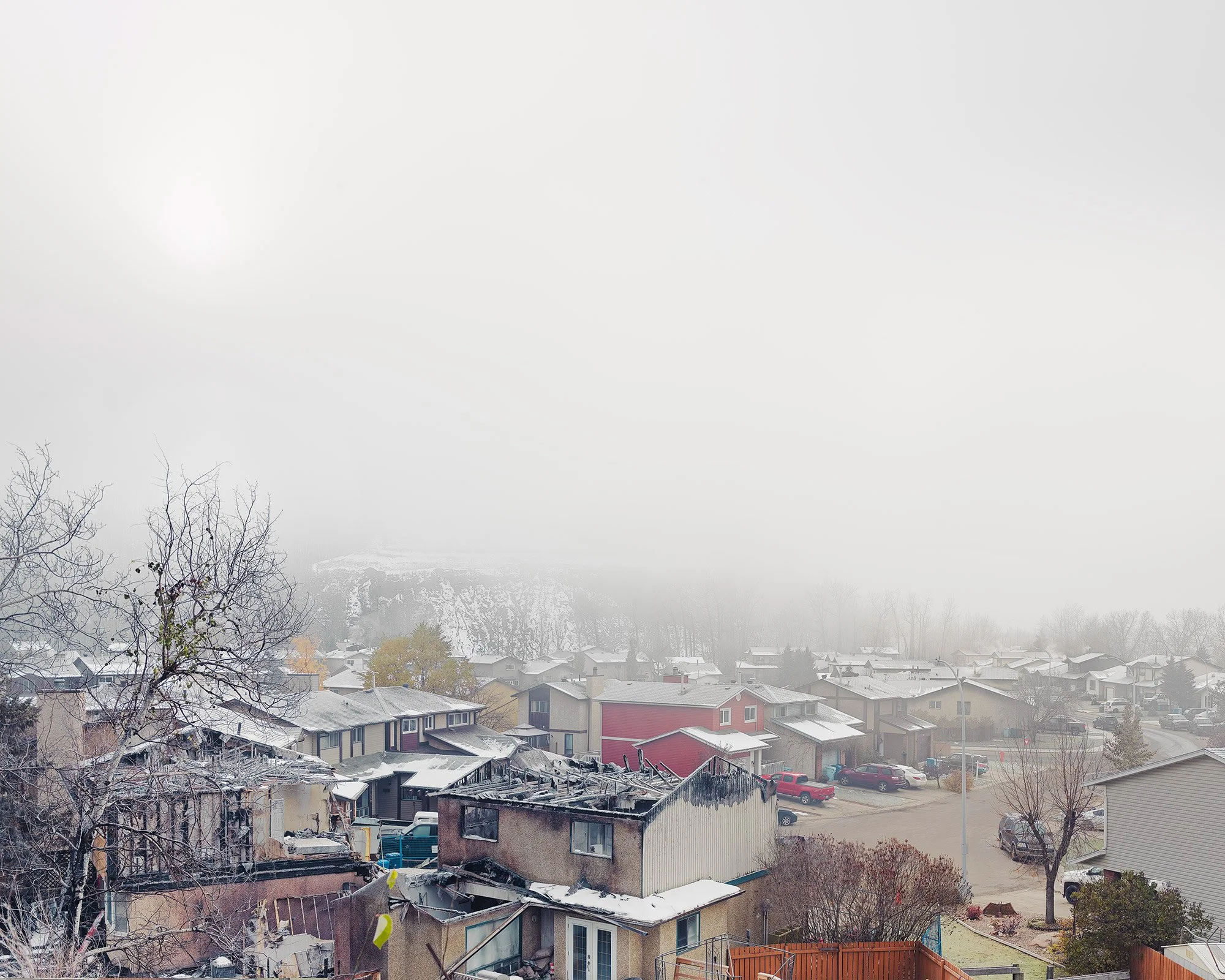
Visual Culture and The Ecology of Art
Alan talks about his collaboration with UCL Anthropology Masters student Emma Mcloughlin as they reach out to the people of Fort McMurray; “The next few weeks will be a wonderful way to reconnect and learn”
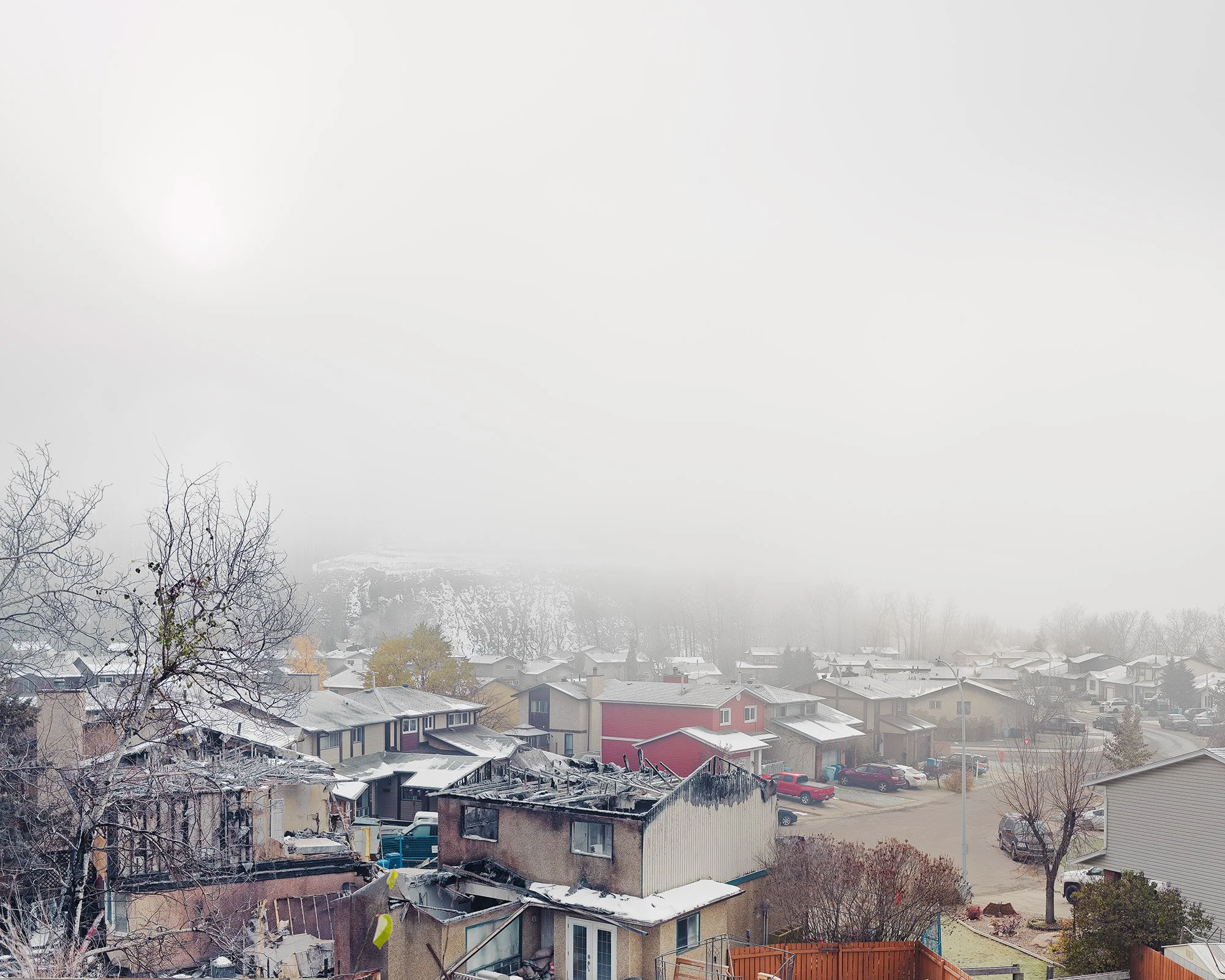
The Straight Crooked, 2017. Large Format Composite Digital, 150cm x 187cm. © Alan McFetridge
Kia ora Everybody,
For the opening exhibition of artist-run gallery g&A Studios, we wanted to locate a body of work that spoke about what it is to be in a space for art that does not rely on the sale of artwork, but the social interactions that happen in-between. The Ecology of Art. We believed that in hanging an art work it symbolised its death and thereby new life could only be created in the flow of ideas streaming through the gallery itself.
Once we found Thomas Hoepker’s photography series depicting the interaction of people, the gallery and artworks in the reopening of New York's MOMA, we had a moment of realisation and immediately contacted Magnum Photos to request the work for exhibition. Thomas’s photographs of people with artwork in a gallery, life and death, became a reflected view, a layer of meaning as people viewed the works in our newly formed gallery - with it, the emergence of new ideas with social currency began. Hoepker’s biography revealed his formative years were rooted in art history and archaeology and by taking on photography he expanded the study directly with its visual form and characteristics.
This year the opportunity to work with the Social Sciences arose when UCL Anthropology Masters student Emma Mcloughlin emailed with questions related to Visual Culture in the Anthropocene. After graduation, the idea of further collaboration was mooted and it was decided to set up an Anthropological study by sending 8% of the print run, 80 copies, of On The Line back to the community of Fort McMurray to ask a range of questions relating to the fire, the experience of fire and what does On The Line do in the social ecology of rebuilding and rememberance.
With the help of the people I met in Fort McMurray during the fieldwork, the next few weeks will be a wonderful way to reconnect and learn more about the fire, but also the 5 years in between as regeneration takes place. I do hope that lessons are learned and these can be shared with others that may find their region becoming more fire-prone and adaptation applied. In relation to landscape ecology: has the fire developed understandings of shaping with fire as a friend?
Become a subscriber on Patreon and Support our Team, call yourself a Center member, or be an Eco Patron.
Don’t forget to follow us on Instagram.
My very best,
Alan

‘Dis/obedience to the Earth’ by University of Westminster Interfaith Team
“What does and does not work in raising awareness of the climate crisis?” Alan will speak on a panel at Westminster University alongside individuals assessing climate action within spiritual communities.
While en route to Hawazin Alotaibi’s (She/Her) solo show with Incubator 21 in Marylebone, Alan bumped into David Morris (Cis-male, any pronouns) the Assistant Interfaith Adviser at The University of Westminster. This chance meeting was unplanned and unexpected; it was both enjoyable and productive despite its short-lived nature.
David is hosting a themed interactive discussion event on Faith and Climate Action at the University of Westminster. Focusing on how to raise awareness of climate change as a consequence of global warming in faith or spiritual communities. This event is sure to be an eye-opening experience for many and challenges all participants to consider: What works, and what doesn’t work, in raising awareness of the climate crisis in your faith or spiritual community?
But let us consider this question broadly, what does and does not work in raising awareness of the climate crisis and to what extent is ‘raising awareness’ currently productive? This kind of thought, outside of faith, is also something David is interested in exploring. David explained that they would like this event to facilitate manifold conversations both within faith and outside of it. In light of the decision to include the secular world within this open discussion, David asked Alan if he would be willing to participate and as I’m sure we can all imagine, Alan was completely enthralled at the proposition and excited to take part.
The Centre for Ecological Philosophy is one which wants to bear witness to and be a part of the different approaches, problems, discourses, studies, and ponderings of Ecology in the present. We love to attend panels, give lectures, participate in discussions, and share work! This space is for collaboration and group exploration of a problem threatening all life on the planet. So far, we have not yet had the pleasure of working with individuals who are assessing climate action within spiritual communities and so we are looking forward to listening to Melanie Nazareth (Christian Climate Action), Mothiur Rahman (Muslims Declare), Dr Jasdev Rai (Sikh Human Rights Group), and many others on their enlightening insights.
We hope to hear from you as well! If you are interested, click here to book your ticket via Eventbrite.
See you Wednesday 17th of November!

Firegrams, 2016 © Alan McFetridge / Combustion Series, Boreal Forest, Fort McMurray, Canada.
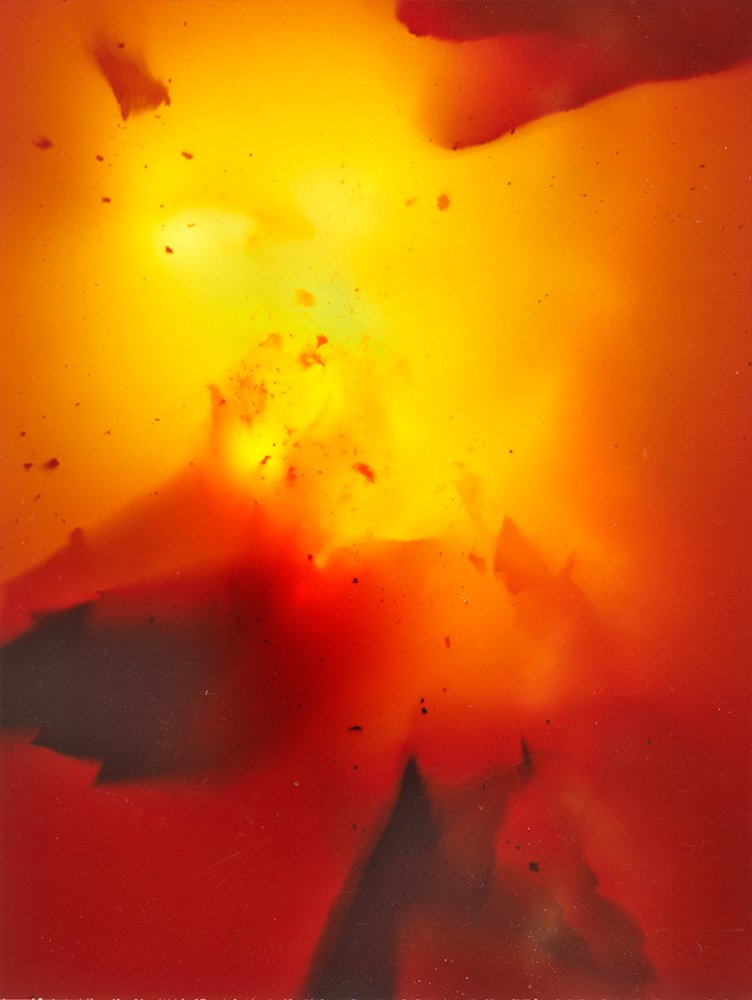
Firegrams, 2016 © Alan McFetridge / Combustion Series, Boreal Forest, Fort McMurray, Canada.
Warmest wishes,
Antoinette Johnson (Any Pronouns)
On The Line, 2019 is available at The Whitechapel Gallery Bookshop, The Photographers’ Gallery Bookshop, and Claire De Rouen Books. It is available for research at the British Library.
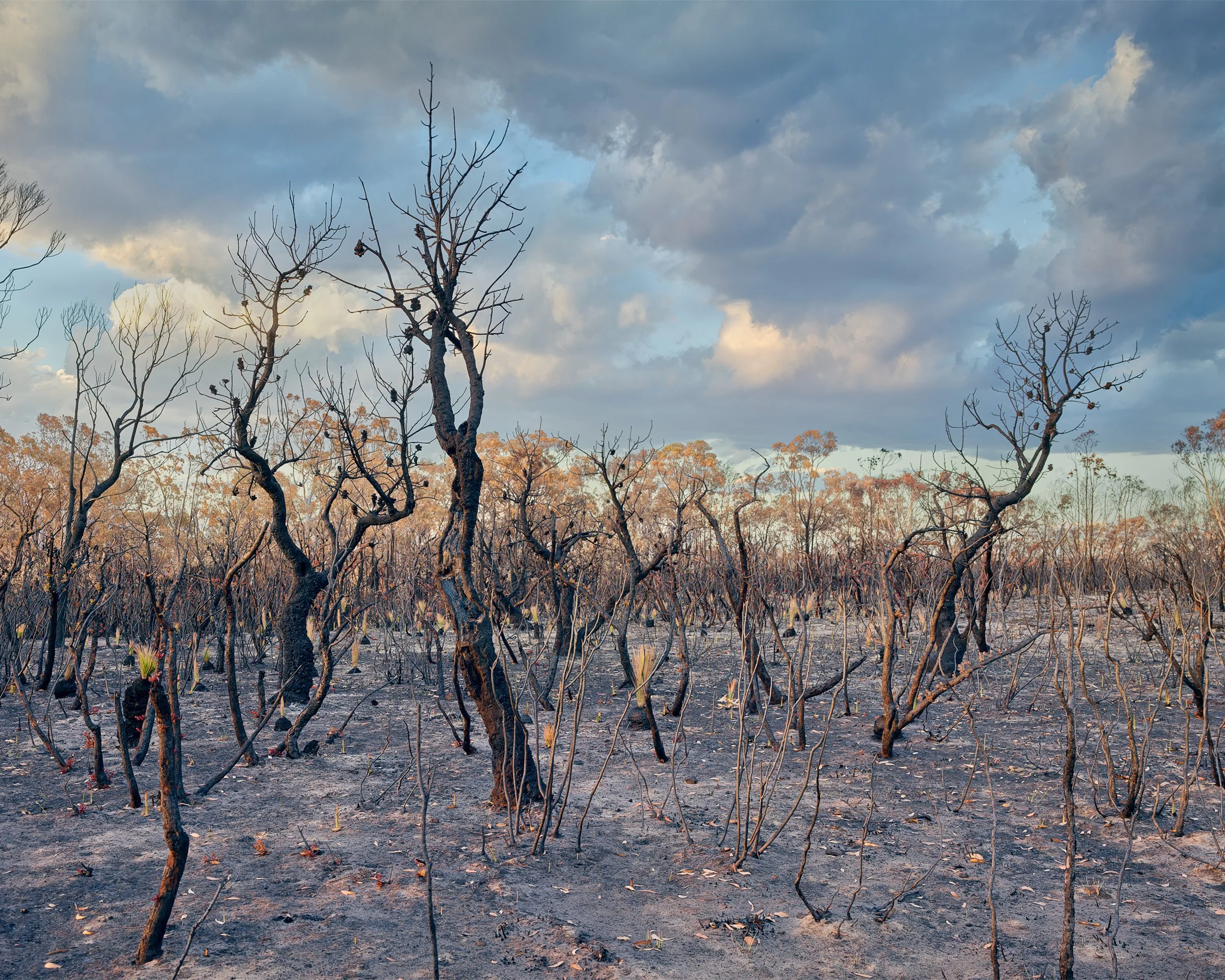
Now you can become a Patron via Patreon
Our research and creativity is part of a collaborative process that involves individuals with varying backgrounds, skills, and education or training. To keep the work moving forward we have joined Patreon.
As Alan McFetridge’s work continues, it has begun to blossom into the Centre for Ecological Philosophy and the team working here at the studio is expanding.

Artifacts and Landscapes from Menai, New South Wales, Australia
Outside of an academic institution, the execution of our research and creativity is part of a collaborative process that involves individuals with varying backgrounds, skills, and education or training.
In light of this, to keep the work moving forward we have joined Patreon, a subscription platform that gives you the possibility of donating to our small research center. To thank you for your contribution, depending on the subscription you choose, you can get free prints, and even discounts, and vouchers for the Alan McFetridge website.
Environmental concerns are shared amongst many of us and it would mean a lot if you could help us find ways to fund the work we want to continue doing. Keep an eye on this blog to find out what is coming next and what your contribution makes possible.
Become a subscriber on Patreon and Support our Team, call yourself a Center member, or be an Eco Patron.
Warmest wishes,
Antoinette Johnson (Any Pronouns)
Don’t forget to follow us on Instagram.
On The Line, 2019 is available at The Whitechapel Gallery Bookshop, The Photographers’ Gallery Bookshop, and Claire De Rouen Books. It is available for research at the British Library.
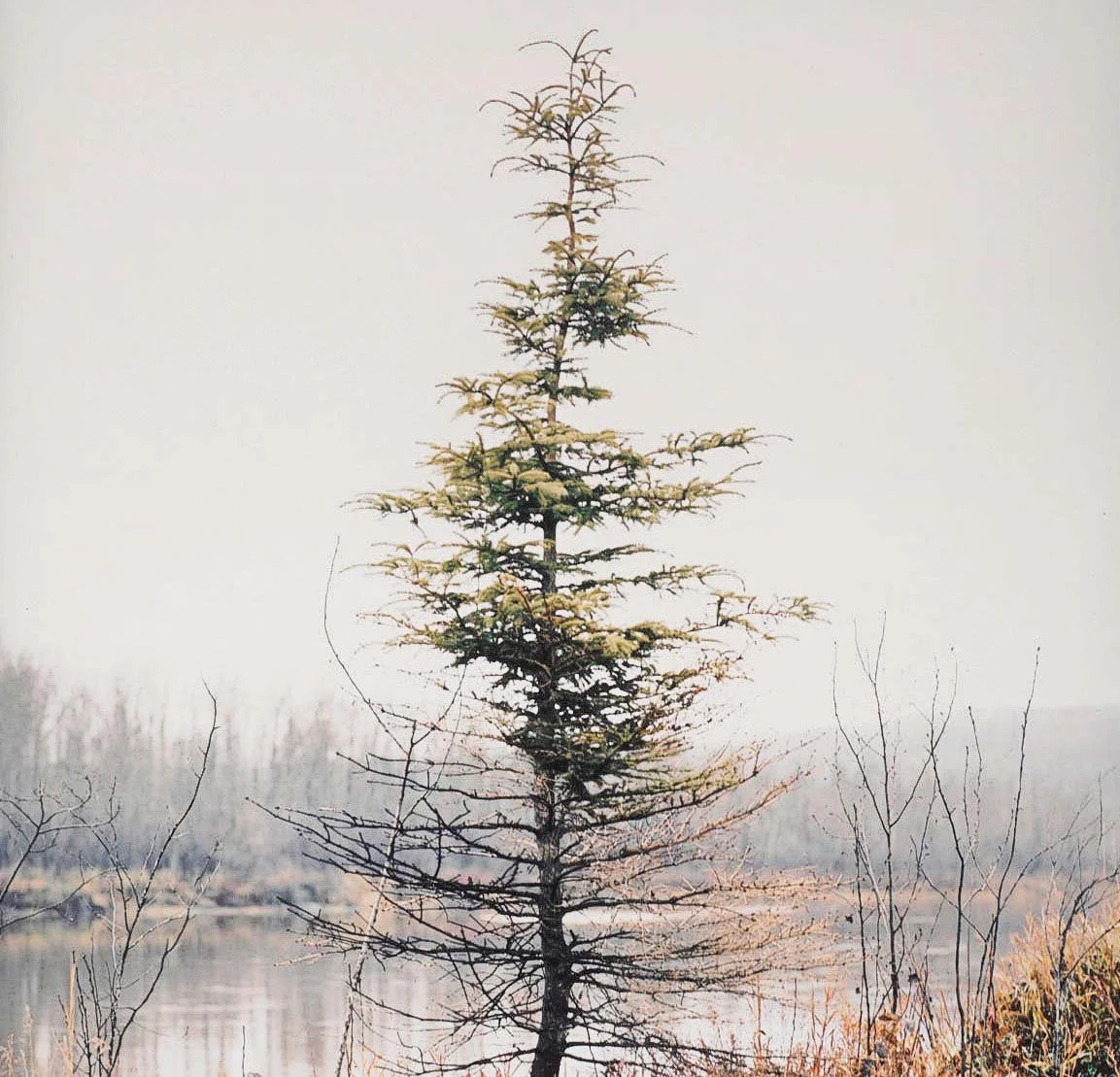
On The Line Reviewed by Photoforum NZ
“...There is a strange, melancholic grace in these images; one whose power contains multiplicities.”
Auckland poet, Michael Steven's writes a compelling review of On The Line for Photoforum NZ.
“...There is a strange, melancholic grace in these images; one whose power contains multiplicities. Not only are each of these photos a spectacle of nature’s waning resilience, they reiterate our implication in the destruction of the natural world…”
You can read the full review here.
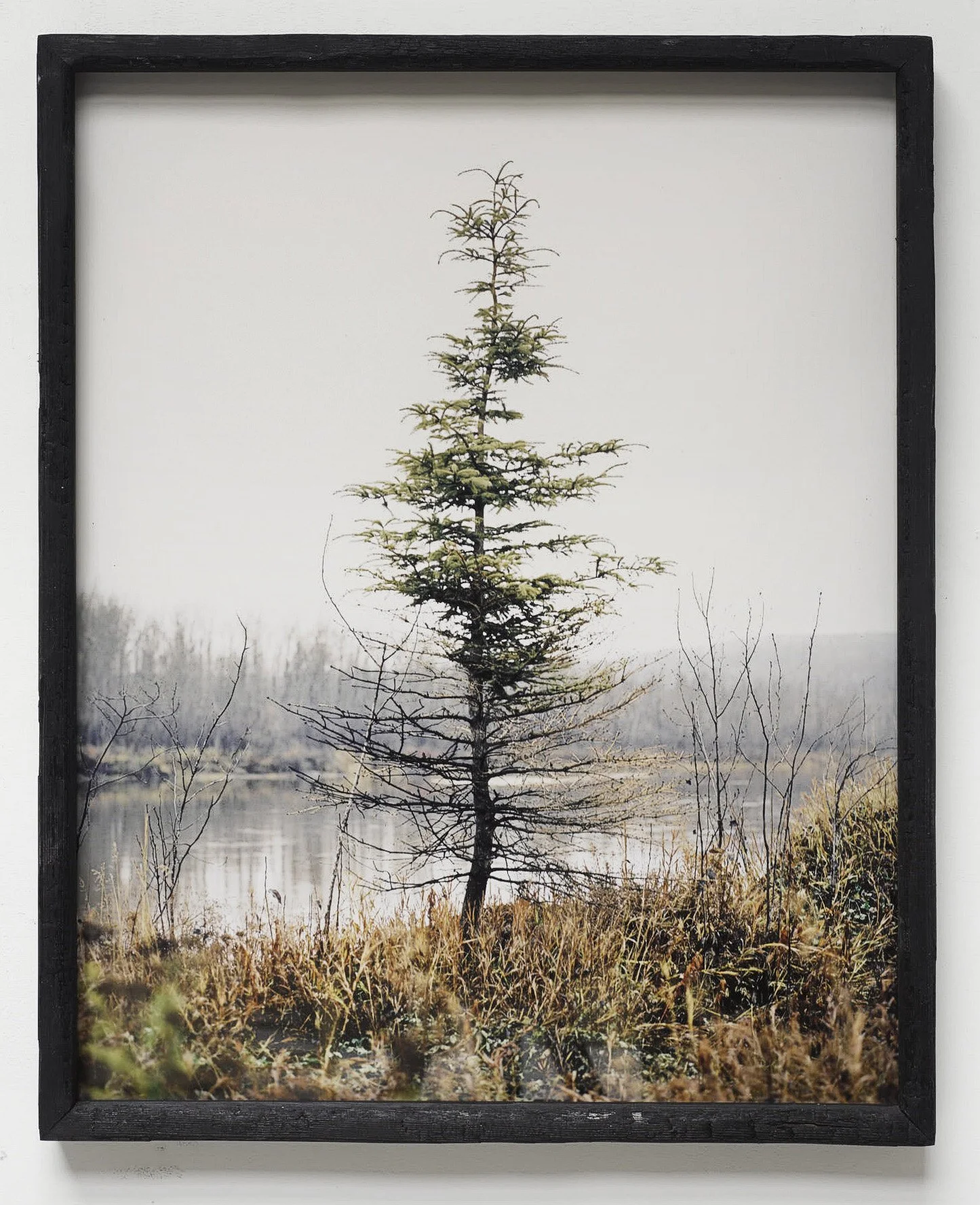
Black Spruce (Picea Mariana), 2016 - Framed Edition
The remaining few first edition copies of On The Line are available for purchase in our prints and books store.
By Connie Boeree (She/Her)
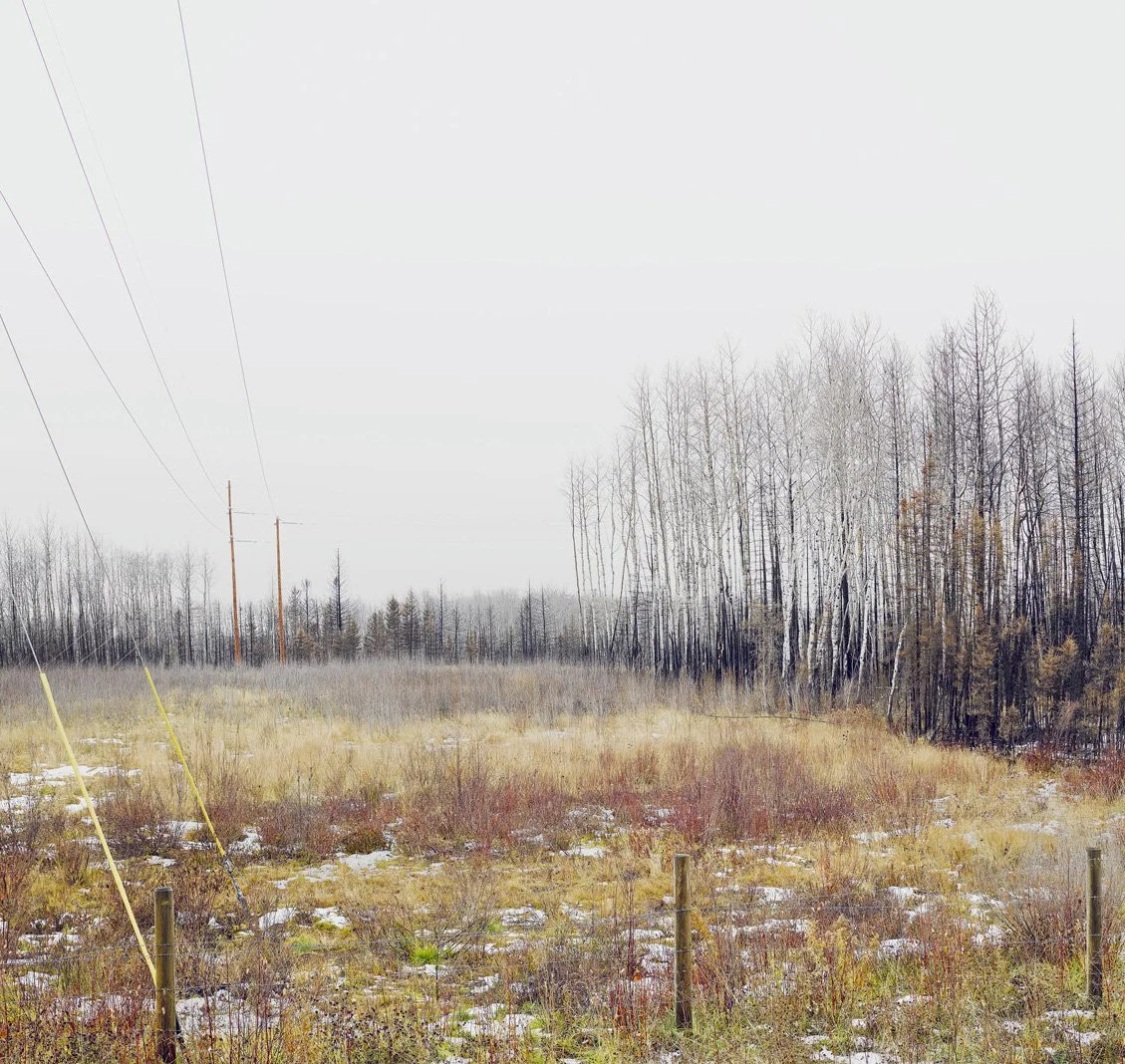
Crude, Cataclysmic and … Manufactured? How the Horse River Fire continues to inform our upcoming monograph
“All living matter is insulated in a thick fur of connectivity, we exist within a network populated with codependent relationships...” Antoinette Johnson introduces the upcoming monograph.
To be alive on Earth, one might argue, is to participate in the global ecosystem. All living matter is insulated in a thick fur of connectivity, we exist within a network populated with codependent relationships. This knowledge is nothing new or special but it is this sense of interconnectedness between the living, the dead, the arbitrary and the dependable forces of the planet that beats in iambic pentameter at the forefront of our developing project.

True to the Last Cinder, 2016 © Alan McFetridge
On The Line documented the aftermath of The Horse River Fire in the urban service area of Fort McMurray. Now this project finds itself in an ongoing chain reaction in response to that initial spark. Fort McMurray is but one example of the impact of climate change on global fire regimes and the research the new monograph aims to accomplish extends beyond Fort McMurray. Exploring geography, history, society, and ecology, the upcoming project, a descendant from On The Line, forces us to come to terms with the fact that the world as we know it is already dead.
The developing monograph amalgamates the allegorical and scientific through documentary-style photography and a transdisciplinary research essay. Not only does it draw attention to the cultural significance of fire in mythology, tales, religion, and belief systems but it discusses the impact of megafires in the Boreal (Taiga) and changing fire regimes on ecological systems.
Again, the incredible Duncan Whyte (He/Him) has completed an outstanding design for the book while Alan McFetridge (He/Him) works closely with a team hoping to grow into a center for Ecological Research and Philosophy. If you would like to support the research, the team, or help fund the production of the new monograph follow us on Instagram and Patreon.
To keep up to date with the progress and work being generated, join our mailing list here.
Warm Wishes,
Antoinette Johnson (Any Pronouns)
On The Line, 2019 is available at The Whitechapel Gallery Bookshop, The Photographers’ Gallery Bookshop, and Claire De Rouen Books. It is available for research at the British Library.
5 Nominations for the Prix Pictet, The Global Award for Photography and Sustainability
The photography work on dispossession has received 5 nominations for the ninth cycle of the Prix Pictet themed - Fire.
Pleased that the work on dispossession has received 5 nominations for the ninth cycle of the Prix Pictet themed - Fire.
Thanks to everyone that has contributed and become friends along the way. It's a nice feeling, sense of more people coming together to accelerate change, showing that piecemeal offers are not enough. We’ll enjoy this, in the hope the exhibition can show the extent and conditions of our now fiery planet. What it means. No celebrations here until significant and rapid changes to global landcare are made, with adaptation of wide spread, long term ecological philosophy - the work will and must continue in earnest - as -‘tears on the faces of stone, they are our own tears’ - James K. Baxter.
Thank you kindly,
Alan.
#newworld #nature #environment #fire #gesamtkunstwerk #photography #philosophy #environment #wildfire #landcare #knowledge # #forest #boundary #frontier #ecology #together

Artist Member of Gallery Climate Coalition
Waste and excess is no longer something to be indifferent about. The concerns of many are being addressed here by the Gallery Climate Coalition through quality information and solutions.
I am pleased to be taking part in GCC’s objectives. Waste and excess is no longer something to be indifferent towards. The concerns of many are being addressed here with quality information and solutions.
The GCC evolved out of shared concern across the commercial art world that not enough is being done to tackle our collective environmental impact. Although public institutions have been taking significant steps to reduce their carbon footprint and control waste for some time, there seemed to be a lack of equivalent initiatives in the commercial sector. This prompted a group of us to set about developing the tools, strategies, and research required to help make a positive change. This is a work in progress. We hope you will join us and make this coalition as effective as possible.
Please email me if you have any questions.
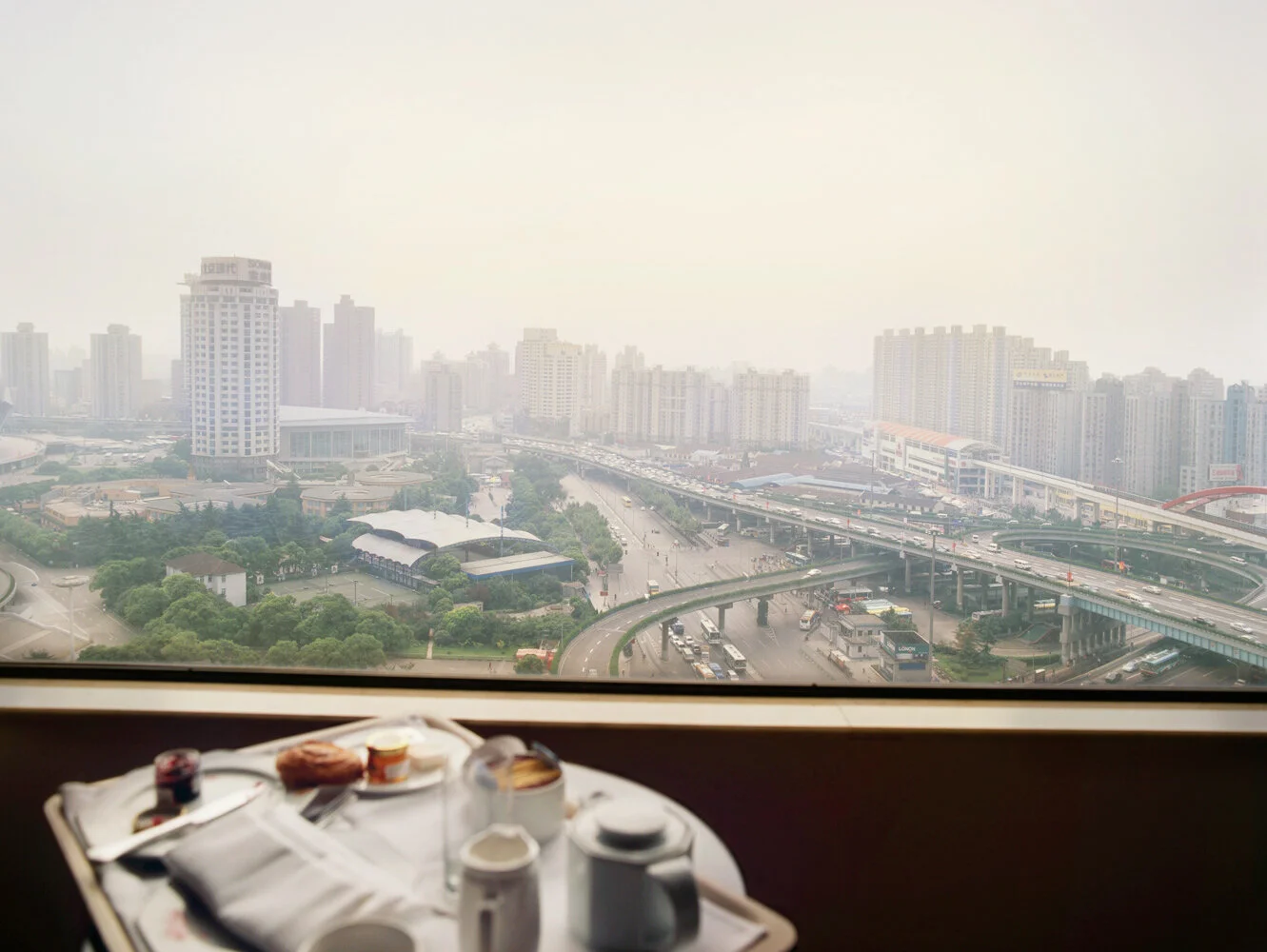
Hotel Room and Smog, 2005. © Alan McFetridge
Wonder + Dread, New Works in Exhibition at Shoalhaven Region Gallery, NSW
Wildfires. Cyclones. Floods. Droughts. Australia is no stranger to extreme weather. These calamitous events, wreaking human and environmental devastation, are central to our shared history and mythology..”
Wonder + Dread: Art in the Land of Weather Extremes.
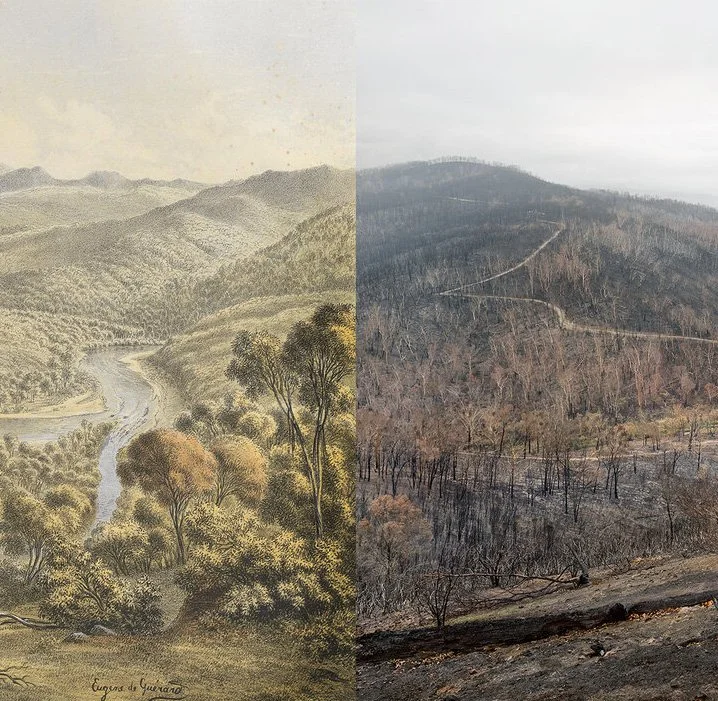
Pleased to announce two new works are included in Wonder + Dread and it is very special to be apart of this crucial debate. Both works are recent diptychs that span 189 years of landscape and applied geographic moderation. The works form part of a project on fire that began 2016.

Junction of the Buchan and Snowy Rivers, Gunaikurnai Country (1881- 2020), 2020,
pigment ink print, diptych: 32.6 × 113cm.
Works Included
1. Junction of the Buchan and Snowy Rivers, Gunaikurnai Country (1881- 2020), 2020
pigment ink print, diptych: 32.6 × 113cm (above)
2. The River Derwent and Hobart Town, Lutruwita (c1831- 2019)
pigment ink print, diptych: 32.6 × 86cm
‘In this series of diptychs, Alan McFetridge has placed prints of 19th century Australian landscape paintings alongside recent photographs taken at the same locations. These comparisons reveal three perspectives. The 19th Century works present a vision of the Australian landscape through a colonial lens. What those early artists unknowingly also captured was a landscape under the careful management of First Nations Peoples. We see thinned trees, epicormic growth, burnt logs within open park-like vistas and fuel reduction. The 20th Century views offer a startling contrast. In Gippsland, the land has been decimated by Black Summer fires. In Tasmania the once carefully managed land has been overrun by trees and scrub.’
-
Reviews
The Australian - Review, Wonder and Dread at Shoalhaven Regional Gallery by Christopher Allen
Alan McFetridge has rephotographed the sites of two colonial views, John Glover’s The River Derwent and Hobart Town (c. 1831) — a picturesque area named “Salvator’s Glen” in recollection of the 17th-century landscapes of the Neapolitan Salvator Rosa — and Eugene von Guerard’s lithograph of the Junction of the Buchan and Snowy Rivers (Plate 9 in Eugene von Guerard’s Australian landscapes, 1866-68). His photographs — of the first site overgrown and the second devastated by bushfire — are set beside reproductions of the originals.
The accompanying label claims that the two painters unwittingly recorded landscapes managed by traditional Aboriginal burning, the cessation of which has brought them to their present state. This may be true, although neither site corresponds to the grassy plains that were particularly noticed by early colonists — some of whom did realise that the Aborigines regularly burned the land — and Von Guerard’s view does not show any obvious signs of fire; there are, however, burnt stumps on the left of Glover’s view and epicormic growth — leaves growing straight from the trunk — on one large tree on the right in particular.
Of course not all fires were either deliberately lit or managed, so it is hard to be sure what happened in this case. The most catastrophic early wild fires recorded and documented in Australia were the Black Thursday Bushfires in Victoria in 1851, the culmination of a terrible drought in the previous year. The fires were witnessed by William Strutt, who made sketches at the time and completed his dramatic painting of the subject after his return to England in 1864. The exhibition contains a reproduction of this painting and one of its studies.
Art Guide Australia by Barney Smith
“Although WONDER + DREAD features a stunning array of art in a Western tradition that seeks to capture and make sense of the spectacular brutality of the Australian climate, Robson is keen to emphasise that the spirit of ancient knowledge hovers decisively over her show too, and that certain things may be revelatory for visitors.” - Barney Smith for Art Guide Australia.
Curator Danielle Robson replies to Barnaby Smith “A key theme that emerged [in WONDER + DREAD] is the tension between the colonial perspective of the Australian landscape as harsh, inhospitable and uninhabitable, and the approach to landscape of First Nations people, who practised traditional land management and thrived for tens of thousands of years,” says Robson.
Full article here
-
Exhibition Details
WONDER + DREAD: Art in the Land of Weather Extremes
Shoalhaven Regional Gallery
12 December – 30 January
Wildfires. Cyclones. Floods. Droughts. Australia is no stranger to extreme weather. These calamitous events, wreaking human and environmental devastation, are central to our shared history and mythology. Those of particular ferocity acquire names that carry through the ages - the Federation Drought, Cyclone Tracey, Black Saturday. And yet, the colossal power of extreme weather systems that indiscriminately obliterate everything in their path leaves us in a state of awe.
Against a backdrop of increasingly frequent extreme weather events, WONDER + DREAD: Art in the Land of Weather Extremes is an ambitious group exhibition of Australian artists that draws on collections from across the country as well as commissioned works to create a thoughtful and nuanced survey of how artists have responded to extreme weather across time.
This exhibition is curated by Danielle Robson of Soda Arts.
Featured Artists
Glenn Barkley, Arthur Boyd, Sam Byrne, Max Dupain, Samuel Elyard, Helga Groves, Rosemary Laing, Marcia Macmillan, Aunty Deidre Martin & Nicole Monks, Alan McFetridge, Joseph McGlennon, Lara Merrett, Sidney Nolan, Susan Norrie, Lloyd Rees, Michael Riley, Cameron Robbins Luke Shadbolt, William Strutt and Albert Tucker.
Acknowledgements
Country, Danielle Robson, David Bowman, Bill Gamage &
Eugene von Guérard (1811 - 1901) Junction of the Buchan and Snowy Rivers, Gippsland (1867)
Provided by National Gallery of Victoria, Melbourne
John Glover, The River Derwent and Hobart Town, c 1851
Reproduction from a digital file courtesy Tasmanian Museum and Art Gallery AG5458
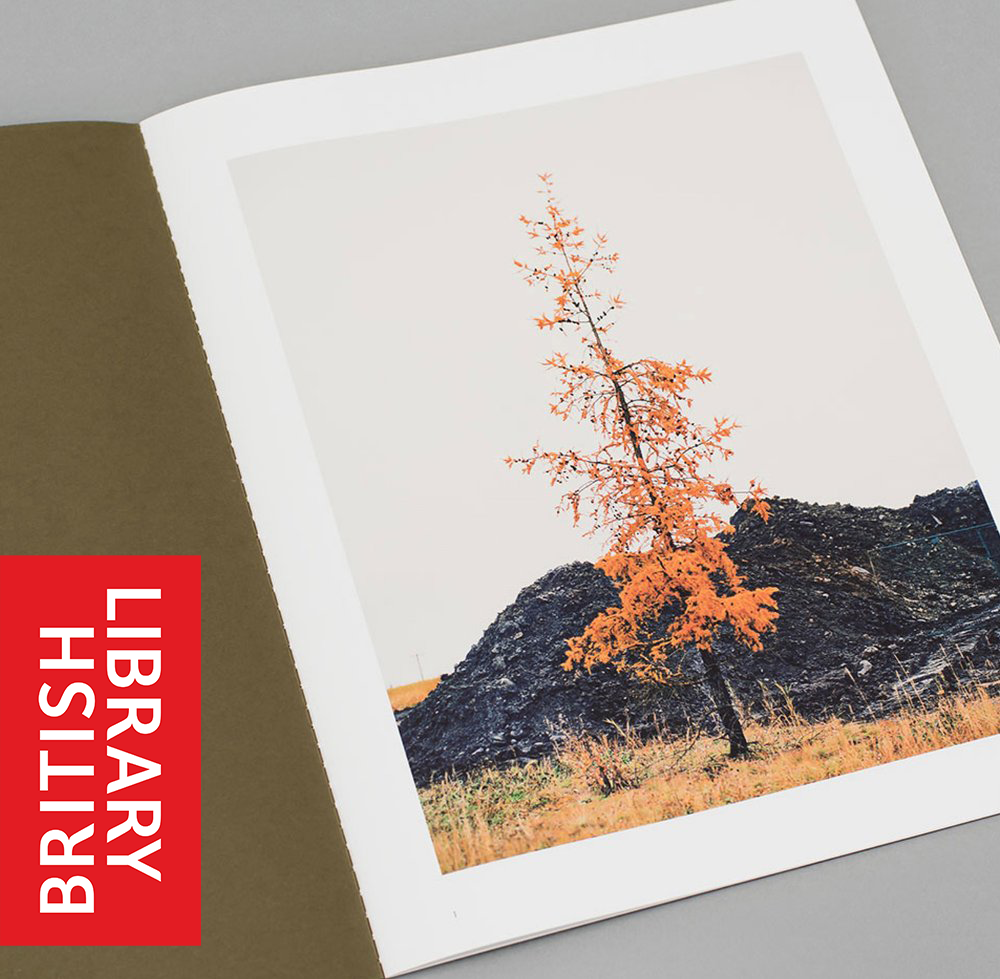
On The Line: featured in the British Library Christmas Blog
It's certainly a wonderful feeling of positive progress when the British Library supports your work and ideas, On The Line is featured in their Christmas Blog.
It's certainly a wonderful feeling of positive progress when the British Library supports your work and ideas, On The Line is featured in their Christmas Blog.
1st edition copies of On The Line are available from my website, Claire De Rouen Books, The Whitechapel Gallery and The Photographers Gallery.

Warmest wishes,
Alan
Territory at Oriel Gallery, Theatr Clwyd, UK with RPS, IPE 162
Territory continues its tour of the UK, exhibit in Wales at the Oriel Gallery.
Territory series tours the UK with the IPE 162
Selected from a worldwide open call and curated by some of the most influential people in photography today, the works exhibited include stark landscapes made during periods of extended solitude, alongside images created using pinhole cameras (made from apples) which celebrate community orchards. Spirituality, family, identity, and inclusion are some of the powerful narratives explored this year
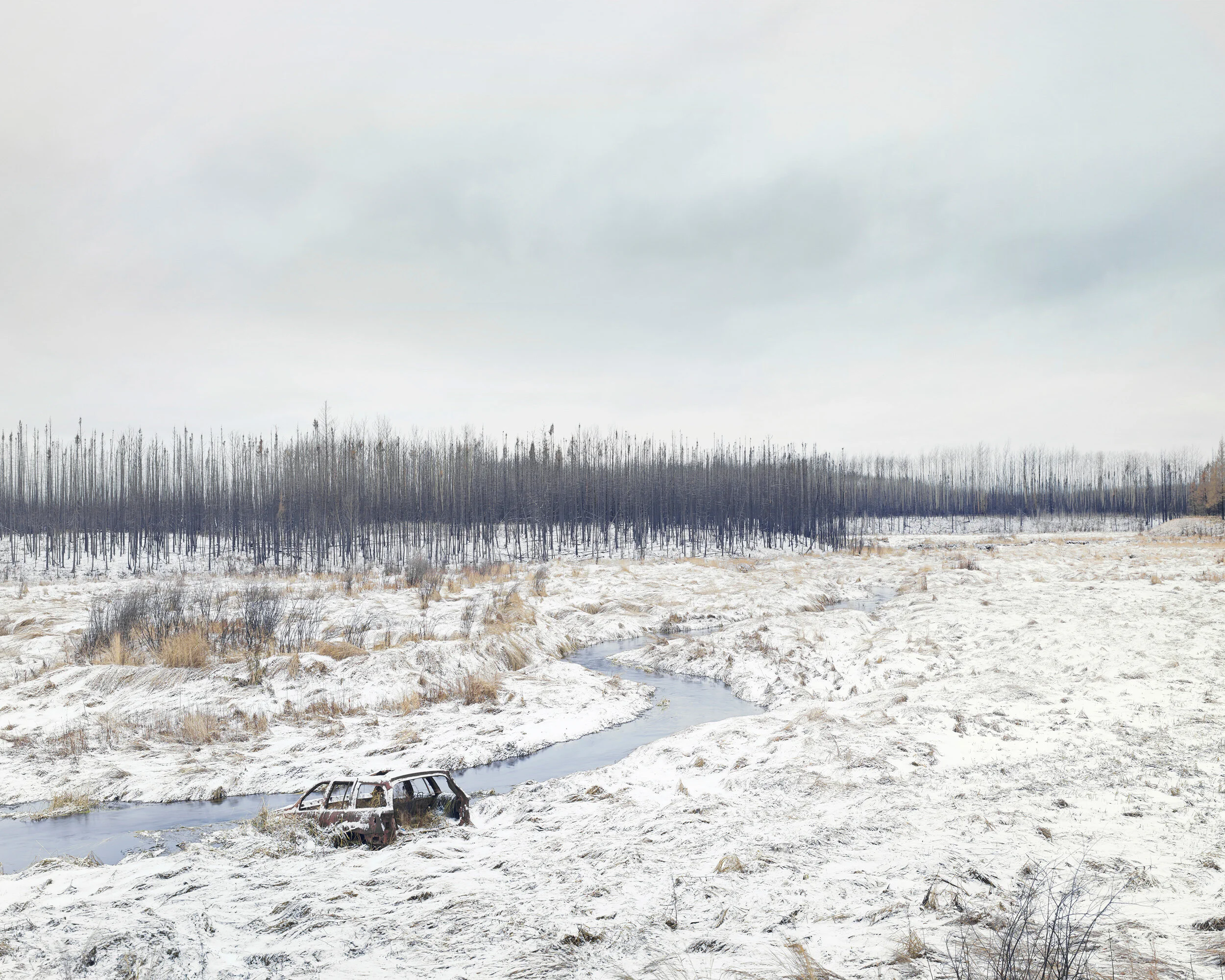
Dead End, 2017 © Alan McFetridge
Exhibition Details
28 November 2020 - 16 January 2021
Gallery Opening Times here
Venue: Oriel Gallery Theatr Clwyd
Raikes Lane, Mold
CH7 1YA
The selection panel included Shannon Ghannam (Global Education Director at Magnum Photos), Skinder Hundal MBE (CEO/Director of New Art Exchange), Yan Wang Preston (Photographic Artist and lecturer at the University of Huddersfield) and Cian Oba-Smith (Editorial and Commercial Photographer), who were joined by RPS Director of Education Dr Michael Pritchard.
If Not Us Then Who, Prints for Community Fund Raising
“Indigenous peoples are leading the climate fight and during this unprecedented pandemic require our support more than ever.”
Proud to be apart of the worldwide Indigenous awareness raising group,
If Not Us Then Who.

Indigenous peoples are leading the climate fight and during this unprecedented pandemic require our support more than ever.
“To us the land is our mother, the forest is our father, and the water is our blood, they give us everything that we need, for this reason we need to do everything that we can to save it.” Fifteen year old Kynan Tegar a photographer / filmmaker from the community of Sungai Utik, Borneo.
Help us to raise funds by purchasing an archival print from the beautiful work available on this site, alternatively please consider donating and read more about where funds will be distributed here and here.