 Image 1 of 5
 Image 2 of 5
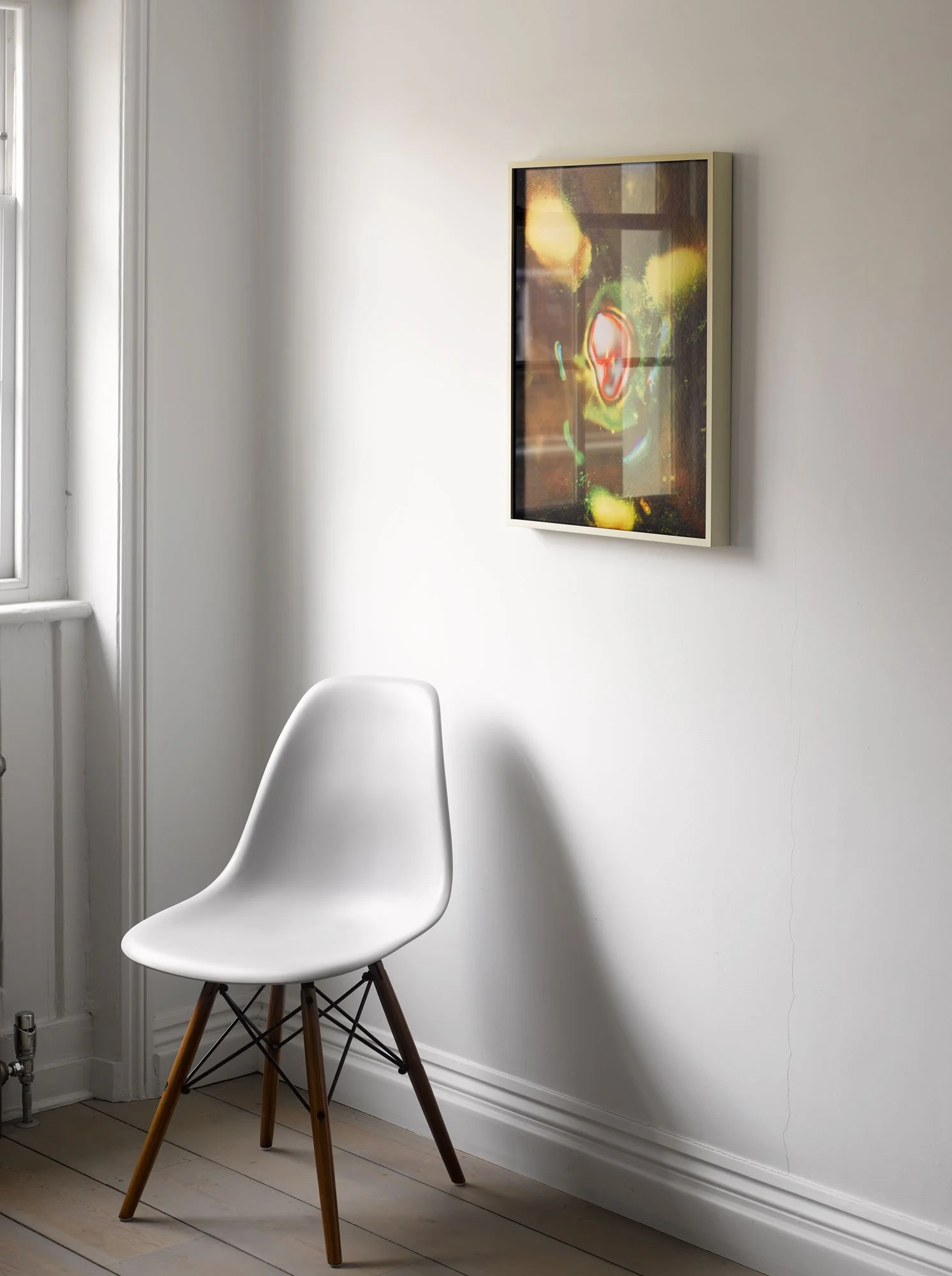 Image 3 of 5
 Image 4 of 5
 Image 5 of 5
Ignis Parnassum, 2023
Ignis Parnassum, 2023
Introduction:
These works rest at the threshold of fire’s essence, transformation. They arise from field studies across Attica, Phocis, and Boeotia, begun in 2021 when Greece suffered one of its most severe wildfire seasons in recent memory, with over 130,000 hectares scorched despite extensive international support. The wider project’s working title is Antiquity in the Pyrocene, which frames social and economic climate solutions alongside Indigenous land care and governance.
As the fire project (est. 2016) continues, I feel compelled to drift from photography’s norms of decisive moments and documentation toward intuition and allegory. The landscapeThe poetry of Aotearoa-born James K. Baxter (1926–1972) and Paul Klee’s Ad Parnassum (1932) profoundly affected me as it enters visual counterpoint and the relations between image, sound, symbol, and the subconscious. During this project, for the first time, I was directly inside an active fire and, at times, caught between the fireline and the cordons around it.
Baxter stands as both prophet and contradiction within Aotearoa’s literary landscape. His poetry fuses biblical intensity with Māori cosmology, colonial guilt with personal confession, and visionary idealism with human fallibility. For decades he was held up as a national conscience, a poet seeking redemption through community, poverty, and fire. Revelations about his behaviour brought to light in 2019 reframed his legacy, asking readers to hold the brilliance of his spiritual vision alongside its harms and hypocrisies.
His 1958 collection In Fires of No Return is poised between youthful rebellion and prophetic conviction. Written during a period of moral searching, it confronts the paradox of destruction and renewal, sin and grace. Fire becomes a metaphor for passage through suffering toward purification, a furnace of self-knowledge and spiritual testing. Baxter saw “progress” as a delusion born of colonial arrogance and industrial greed. He railed against the suburban morality of post-war New Zealand, “the disease of middle-class respectability”, which prized comfort and property over truth, compassion, and spiritual life. In essays such as “The Fire and the Anvil” and “Recent Trends in New Zealand Poetry” (1951), he argued that genuine progress requires moral and imaginative renewal, not mere economic growth. His later Jerusalem writings reframed progress as return, a movement back toward humility, land, and the sacred.
Painted in Klee’s late Bauhaus period, Ad Parnassum (1932), Latin for “Toward Parnassus”, is often read as the artist’s summit, technically and spiritually. Built from thousands of small, luminous colour squares into a pyramidal form reminiscent of Mount Parnassos, home of Apollo and the Muses, the work merges architecture, painting, and music, each mark like a note in a complex fugue ascending toward harmony. It fuses geometry and intuition, reason and revelation, on the cusp of Klee’s departure from the Bauhaus and Europe’s gathering political storm.
Cave and Chasm - a Landscape of Partnerships
Fieldwork began on 18 August 2021 and continues, with new work made in 2023 and 2025. Ignis Parnassum is the first work to be released and is a collaboration. In 2021, after time at the active fire front near Vilia in Attica, I travelled to Parnassos about 135 km northwest. I spent several days at the summit, sleeping in a rental van, then descended to process and replenish supplies. Looking somewhat dishevelled, I was approached by an elderly man who said, “Stranger, I have come to tell you about the cave and the chasm in the mountain that you must visit,” handing me a map of both.
After several days in the cave, I phoned a friend in London who was shocked I wasn’t near the fires. I returned to Vilia, knowing it would now be ash. What followed were two opposed events. First, an invitation to a weekend gathering in the square, a glimpse of traditional village life. Then, the next day, after a large fire broke out on the far side of Vilia, I was seized by militia, held in police custody, and interrogated by Fire Inspectors.
I retreated to the mountain and rested at the chasm, far from the chaos, among birds and faithful trees. At sunrise I heard an approaching car and feared the worst. Instead I was greeted by two women in 1990s ski suits. This was the beginning of my collaboration with Eva Papadopoulos.
Pyrogram Process
A pyrogram is an image made with flame, found materials, and plants. Working in darkness, photographic paper or film is exposed to fire’s light, smoke, and heated fragments suspended above it. The process is an active burn. The first ignition surrenders control. Accidents happen. With time, reactions are learned and guidance returns.
Each mark is both accident and intent, a collaboration with fire as material, agent, and oracle. Unlike conventional photography, which fixes light through chemistry, pyrograms carry the immediacy of risk, the possibility of complete loss. They echo fire’s ancient role in ceremony and the contemporary forces reshaping landscapes. Serendipity here is not transformation but awareness, the unexpected recognition that arises while seeking.
Photography historian Dr Michael Pritchard notes he can find no precedent for photographic artworks produced directly with fire before my 2016 work. While other artists have used burning as a destructive gesture, only photography renders images this way, with flame as the instrument of exposure. Pritchard describes the pyrogram as “a distinctive approach to image making… fire is certainly a new one to me.”
Purpose and Support
Proceeds from the sale of this work support the continuation of Antiquity in the Pyrocene, a long-term study connecting fire, myth, and ecology through fieldwork, education, and community exchange. Funds contribute directly to travel, materials, and collaborations with local artists, historians, and land stewards in Greece and beyond.
Each edition purchased helps sustain this evolving body of work and its goal to rekindle cultural memory and ecological care in landscapes shaped by fire.
Artists: Eva Papadopoulos & Alan McFetridge
Original: Fuji Instant Colour Film FP-100C,
Size: 102mm X 131 mm
First Edition: Chroma Print on Archival Paper
Size: 58cm X 44 cm
Edition: 7 + 2 AP
Availability: 6 editions + 2 AP remaining
2nd Edition: Chroma Print on Archival Paper
Size: 130cm x 100cm
Edition 5 + 1AP
Open Edition: Chroma Print on Archival Paper
Size: 21cm x 29.7cm archival sheet with the image printed at original instant scale (131 × 102 mm), centred with generous borders.
Please email alan@alan-mcfetridge.com
Ignis Parnassum, 2023
Introduction:
These works rest at the threshold of fire’s essence, transformation. They arise from field studies across Attica, Phocis, and Boeotia, begun in 2021 when Greece suffered one of its most severe wildfire seasons in recent memory, with over 130,000 hectares scorched despite extensive international support. The wider project’s working title is Antiquity in the Pyrocene, which frames social and economic climate solutions alongside Indigenous land care and governance.
As the fire project (est. 2016) continues, I feel compelled to drift from photography’s norms of decisive moments and documentation toward intuition and allegory. The landscapeThe poetry of Aotearoa-born James K. Baxter (1926–1972) and Paul Klee’s Ad Parnassum (1932) profoundly affected me as it enters visual counterpoint and the relations between image, sound, symbol, and the subconscious. During this project, for the first time, I was directly inside an active fire and, at times, caught between the fireline and the cordons around it.
Baxter stands as both prophet and contradiction within Aotearoa’s literary landscape. His poetry fuses biblical intensity with Māori cosmology, colonial guilt with personal confession, and visionary idealism with human fallibility. For decades he was held up as a national conscience, a poet seeking redemption through community, poverty, and fire. Revelations about his behaviour brought to light in 2019 reframed his legacy, asking readers to hold the brilliance of his spiritual vision alongside its harms and hypocrisies.
His 1958 collection In Fires of No Return is poised between youthful rebellion and prophetic conviction. Written during a period of moral searching, it confronts the paradox of destruction and renewal, sin and grace. Fire becomes a metaphor for passage through suffering toward purification, a furnace of self-knowledge and spiritual testing. Baxter saw “progress” as a delusion born of colonial arrogance and industrial greed. He railed against the suburban morality of post-war New Zealand, “the disease of middle-class respectability”, which prized comfort and property over truth, compassion, and spiritual life. In essays such as “The Fire and the Anvil” and “Recent Trends in New Zealand Poetry” (1951), he argued that genuine progress requires moral and imaginative renewal, not mere economic growth. His later Jerusalem writings reframed progress as return, a movement back toward humility, land, and the sacred.
Painted in Klee’s late Bauhaus period, Ad Parnassum (1932), Latin for “Toward Parnassus”, is often read as the artist’s summit, technically and spiritually. Built from thousands of small, luminous colour squares into a pyramidal form reminiscent of Mount Parnassos, home of Apollo and the Muses, the work merges architecture, painting, and music, each mark like a note in a complex fugue ascending toward harmony. It fuses geometry and intuition, reason and revelation, on the cusp of Klee’s departure from the Bauhaus and Europe’s gathering political storm.
Cave and Chasm - a Landscape of Partnerships
Fieldwork began on 18 August 2021 and continues, with new work made in 2023 and 2025. Ignis Parnassum is the first work to be released and is a collaboration. In 2021, after time at the active fire front near Vilia in Attica, I travelled to Parnassos about 135 km northwest. I spent several days at the summit, sleeping in a rental van, then descended to process and replenish supplies. Looking somewhat dishevelled, I was approached by an elderly man who said, “Stranger, I have come to tell you about the cave and the chasm in the mountain that you must visit,” handing me a map of both.
After several days in the cave, I phoned a friend in London who was shocked I wasn’t near the fires. I returned to Vilia, knowing it would now be ash. What followed were two opposed events. First, an invitation to a weekend gathering in the square, a glimpse of traditional village life. Then, the next day, after a large fire broke out on the far side of Vilia, I was seized by militia, held in police custody, and interrogated by Fire Inspectors.
I retreated to the mountain and rested at the chasm, far from the chaos, among birds and faithful trees. At sunrise I heard an approaching car and feared the worst. Instead I was greeted by two women in 1990s ski suits. This was the beginning of my collaboration with Eva Papadopoulos.
Pyrogram Process
A pyrogram is an image made with flame, found materials, and plants. Working in darkness, photographic paper or film is exposed to fire’s light, smoke, and heated fragments suspended above it. The process is an active burn. The first ignition surrenders control. Accidents happen. With time, reactions are learned and guidance returns.
Each mark is both accident and intent, a collaboration with fire as material, agent, and oracle. Unlike conventional photography, which fixes light through chemistry, pyrograms carry the immediacy of risk, the possibility of complete loss. They echo fire’s ancient role in ceremony and the contemporary forces reshaping landscapes. Serendipity here is not transformation but awareness, the unexpected recognition that arises while seeking.
Photography historian Dr Michael Pritchard notes he can find no precedent for photographic artworks produced directly with fire before my 2016 work. While other artists have used burning as a destructive gesture, only photography renders images this way, with flame as the instrument of exposure. Pritchard describes the pyrogram as “a distinctive approach to image making… fire is certainly a new one to me.”
Purpose and Support
Proceeds from the sale of this work support the continuation of Antiquity in the Pyrocene, a long-term study connecting fire, myth, and ecology through fieldwork, education, and community exchange. Funds contribute directly to travel, materials, and collaborations with local artists, historians, and land stewards in Greece and beyond.
Each edition purchased helps sustain this evolving body of work and its goal to rekindle cultural memory and ecological care in landscapes shaped by fire.
Artists: Eva Papadopoulos & Alan McFetridge
Original: Fuji Instant Colour Film FP-100C,
Size: 102mm X 131 mm
First Edition: Chroma Print on Archival Paper
Size: 58cm X 44 cm
Edition: 7 + 2 AP
Availability: 6 editions + 2 AP remaining
2nd Edition: Chroma Print on Archival Paper
Size: 130cm x 100cm
Edition 5 + 1AP
Open Edition: Chroma Print on Archival Paper
Size: 21cm x 29.7cm archival sheet with the image printed at original instant scale (131 × 102 mm), centred with generous borders.
Please email alan@alan-mcfetridge.com